<?xml version="1.0" encoding="ISO-8859-1"?><article xmlns:mml="http://www.w3.org/1998/Math/MathML" xmlns:xlink="http://www.w3.org/1999/xlink" xmlns:xsi="http://www.w3.org/2001/XMLSchema-instance">
<front>
<journal-meta>
<journal-id>0009-6725</journal-id>
<journal-title><![CDATA[Ciência e Cultura]]></journal-title>
<abbrev-journal-title><![CDATA[Cienc. Cult.]]></abbrev-journal-title>
<issn>0009-6725</issn>
<publisher>
<publisher-name><![CDATA[Sociedade Brasileira para o Progresso da Ciência]]></publisher-name>
</publisher>
</journal-meta>
<article-meta>
<article-id>S0009-67252024000200012</article-id>
<article-id pub-id-type="doi">10.5935/2317-6660.20240032</article-id>
<title-group>
<article-title xml:lang="en"><![CDATA[Land-use in Amazonia and the Cerrado of Brazil]]></article-title>
</title-group>
<contrib-group>
<contrib contrib-type="author">
<name>
<surname><![CDATA[Nepstad]]></surname>
<given-names><![CDATA[Daniel Curtis]]></given-names>
</name>
<xref ref-type="aff" rid="A1 "/>
<xref ref-type="aff" rid="A A"/>
<xref ref-type="aff" rid="AA4"/>
</contrib>
</contrib-group>
<aff id="AA1">
<institution><![CDATA[,Universidade Federal do Pará  ]]></institution>
<addr-line><![CDATA[ ]]></addr-line>
</aff>
<aff id="AA2">
<institution><![CDATA[,Instituto de Pesquisa Ambiental da Amazônia  ]]></institution>
<addr-line><![CDATA[ ]]></addr-line>
</aff>
<aff id="AA3">
<institution><![CDATA[,Yale University  ]]></institution>
<addr-line><![CDATA[ ]]></addr-line>
</aff>
<aff id="AA4">
<institution><![CDATA[,The Woods Hole Research Center  ]]></institution>
<addr-line><![CDATA[ ]]></addr-line>
</aff>
<pub-date pub-type="pub">
<day>00</day>
<month>04</month>
<year>2024</year>
</pub-date>
<pub-date pub-type="epub">
<day>00</day>
<month>04</month>
<year>2024</year>
</pub-date>
<volume>76</volume>
<numero>2</numero>
<fpage>01</fpage>
<lpage>22</lpage>
<copyright-statement/>
<copyright-year/>
<self-uri xlink:href="http://cienciaecultura.bvs.br/scielo.php?script=sci_arttext&amp;pid=S0009-67252024000200012&amp;lng=en&amp;nrm=iso"></self-uri><self-uri xlink:href="http://cienciaecultura.bvs.br/scielo.php?script=sci_abstract&amp;pid=S0009-67252024000200012&amp;lng=en&amp;nrm=iso"></self-uri><self-uri xlink:href="http://cienciaecultura.bvs.br/scielo.php?script=sci_pdf&amp;pid=S0009-67252024000200012&amp;lng=en&amp;nrm=iso"></self-uri><abstract abstract-type="short" xml:lang="en"><p><![CDATA[The total area and annual rate of native vegetation clearing is greatest in the Cerrado region, followed by the Brazilian states of Pará, Mato Grosso, Maranhão, and Rondônia. Amazonian forest clearing proceeds most quickly where abundant natural resources (wood or land) are accessible by roads and close to markets. These regions are concentrated along the eastern and southern flanks of Amazonia, particularly in eastern Pará, Cuiabá, and Rondônia. There are still large discrepancies in estimates of annual deforestation: Landsat (Thematic Mapper-Based) mapping of deforestation in the closed canopy forests of Amazonia has not included non-Brazilian countries and is incomplete for the Cerrado biome. Amazonian deforestation was last mapped in 1994. Current estimates of Amazonian forest clearing do not include most of the forests there are affected by logging each year, which is an area (about 7000 km² yr) more than half the size of the area of annual deforestation. Logging changes forest structure and increases forest flammability. The intensity of logging ranges from one to 100 species harvest, in averages 20 m³ of wood harvested per hectare. Logging may increase dramatically in the coming years. Fire affects large but difficult to measure areas of pastureland, logged forests, secondary forests and primary forests. Forest ground fires are particularly difficult to map from satellite data. Fire is more frequent where forest clearing is taking place and where seasonal drought is more severe. The destiny of Amazonian forestland cleared for crops and cattle pastor is complex and highly variable regionally. Aerial estimates are needed for managed pastures, the graded pastures, cropland, and secondary forests for these ecosystems and functionally distinct. Most forest clearing is for pasture establishment, followed by shifting cultivation. Cattle pasture is the logical land use for both small scale and large scale rural Amazonians because cattle are easily sold or traded, and they maintain their value during inflation. Cattle pasture help secure land claims and increase land value. In the Cerrado, there has been a shift from extensive cattle grazing of natural savannas took pastures planted with African forage grasses; mechanized soybean production is the second most extensive land use. Pastures are the most important land covers for the LBA (large scale biosphere-atmosphere experiment in Amazonia) science campaign. Brazilian Amazonian experienced reduced rainfall during ENSO events. ENSO-related drought is most severe in eastern Amazonia. Amazing wide reduction in rainfall would have its greatest effect on vegetation near the border between Savannah and closed canopy forest in Rondônia, Mato Grosso, Pará, and Tocantins. The LBA campaign should be conducted in a variety of rural landscapes to capture the multiplicity of human effects on all native ecosystems, as well as the range of climatic and edaphic conditions under which these ecosystems have evolved. It should address the current (ENSO) and predicted variations in climate, and should be designed to recommend those land users that best reconcile the maintenance of ecosystems processes with socially equitable economic growth.]]></p></abstract>
<abstract abstract-type="short" xml:lang="pt"><p><![CDATA[O desmatamento da vegetação nativa do Cerrado e da Amazônia tem sido incrementado por vetores, tais como estradas e pela proximidade de centros consumidores. Ainda existem discrepâncias nas estimativas da área desmatada obtidas pelo Landsat TM em florestas fechadas da Amazônia, bem como nos Cerrados, sendo que o último mapeamento foi realizado em 1994. Estimativas atuais de desmatamento na Amazônia não consideram o corte seletivo, o qual pode atingir uma área estimada como sendo metade daquela de toda área desmatada. Além disso, o corte seletivo, que oscila entre 1 até 100 espécies, atingindo uma média de 20 m³ de madeira retirada por hectare, pode alterar a estrutura e aumenta a inflamabilidade da floresta. As Queimadas afetam sobremaneira (ainda que é difícil de serem mensurados) as áreas de pastagem, florestas primárias e secundárias. O fogo rasteiro é difícil de ser detectado por satélites, sendo mais frequente por ocasião do desmate, bem como na época da seca, muito embora essas relações ainda não tenham sido estudadas. Na Amazônia o destino das antigas áreas de florestas que se transformarão em pastos ou áreas cultiváveis é complexo e dependente da região. Um inventário anual de cada um desses segmentos de uso de solo torna-se necessário, uma vez que cada ecossistema funciona de modo distinto. A maior parte das áreas desmatadas tem sido usada para pastagem, uma vez que o gado é um produto de alta liquidez, além do que ajuda a manter a ocupação do solo e seu valor comercial. No Cerrado tem se observado uma mudança nas pastagens antes composta por savanas naturais, agora por vegetação exótica africana. A produção mecanizada de soja é a segunda maior atividade quanto ao uso do solo na região. Esta matriz complexa composta por vários ecossistemas com usos, funcionamento e perspectivas tão diferentes deve ser a base de programas voltados para o estudo desta região, buscando assim a manutenção dos processos naturais associadas ao crescimento econômico de igualdade social.]]></p></abstract>
<kwd-group>
<kwd lng="en"><![CDATA[Cerrado]]></kwd>
<kwd lng="en"><![CDATA[Amazônia]]></kwd>
<kwd lng="en"><![CDATA[Desmatamento]]></kwd>
<kwd lng="en"><![CDATA[Ocupação]]></kwd>
<kwd lng="en"><![CDATA[Manejo]]></kwd>
<kwd lng="pt"><![CDATA[Cerrado]]></kwd>
<kwd lng="pt"><![CDATA[Amazônia]]></kwd>
<kwd lng="pt"><![CDATA[Desmatamento]]></kwd>
<kwd lng="pt"><![CDATA[Ocupação]]></kwd>
<kwd lng="pt"><![CDATA[Manejo]]></kwd>
</kwd-group>
</article-meta>
</front><body><![CDATA[ <p align="right"><font size="2" face="Verdana, Arial, Helvetica, sans-serif"><b>ARTIGO</b></font></p>     <p>&nbsp;</p>     <p><font size="3" face="Verdana, Arial, Helvetica, sans-serif"><b>Land-use in Amazonia and the Cerrado of Brazil</b></font></p>     <p>&nbsp;</p>     <p>&nbsp;</p>     <p><font size="2" face="Verdana, Arial, Helvetica, sans-serif"><b>Daniel Curtis Nepstad</b></font></p>     <p><font size="2" face="Verdana, Arial, Helvetica, sans-serif">Professor da Universidade Federal do Par&aacute;, pesquisador membro/associado do Instituto de Pesquisa Ambiental da Amaz&ocirc;nia, palestrante da Yale University e pesquisador associado da The Woods Hole Research Center</font></p>     <p>&nbsp;</p>     <p>&nbsp;</p> <hr size="1" noshade>     <p><font size="2" face="Verdana, Arial, Helvetica, sans-serif"><b>ABSTRACT</b></font></p>     ]]></body>
<body><![CDATA[<p><font size="2" face="Verdana, Arial, Helvetica, sans-serif">The total area and annual rate of native vegetation clearing is greatest in the Cerrado region, followed by the Brazilian states of Par&aacute;, Mato Grosso, Maranh&atilde;o, and Rond&ocirc;nia. Amazonian forest clearing proceeds most quickly where abundant natural resources (wood or land) are accessible by roads and close to markets. These regions are concentrated along the eastern and southern flanks of Amazonia, particularly in eastern Par&aacute;, Cuiab&aacute;, and Rond&ocirc;nia. There are still large discrepancies in estimates of annual deforestation: Landsat (Thematic Mapper-Based) mapping of deforestation in the closed canopy forests of Amazonia has not included non-Brazilian countries and is incomplete for the Cerrado biome. Amazonian deforestation was last mapped in 1994. Current estimates of Amazonian forest clearing do not include most of the forests there are affected by logging each year, which is an area (about 7000 km<sup>2</sup> yr) more than half the size of the area of annual deforestation. Logging changes forest structure and increases forest flammability. The intensity of logging ranges from one to 100 species harvest, in averages 20 m<sup>3</sup> of wood harvested per hectare. Logging may increase dramatically in the coming years. Fire affects large but difficult to measure areas of pastureland, logged forests, secondary forests and primary forests. Forest ground fires are particularly difficult to map from satellite data. Fire is more frequent where forest clearing is taking place and where seasonal drought is more severe. The destiny of Amazonian forestland cleared for crops and cattle pastor is complex and highly variable regionally. Aerial estimates are needed for managed pastures, the graded pastures, cropland, and secondary forests for these ecosystems and functionally distinct. Most forest clearing is for pasture establishment, followed by shifting cultivation. Cattle pasture is the logical land use for both small scale and large scale rural Amazonians because cattle are easily sold or traded, and they maintain their value during inflation. Cattle pasture help secure land claims and increase land value. In the Cerrado, there has been a shift from extensive cattle grazing of natural savannas took pastures planted with African forage grasses; mechanized soybean production is the second most extensive land use. Pastures are the most important land covers for the LBA (large scale biosphere-atmosphere experiment in Amazonia) science campaign. Brazilian Amazonian experienced reduced rainfall during ENSO events. ENSO-related drought is most severe in eastern Amazonia. Amazing wide reduction in rainfall would have its greatest effect on vegetation near the border between Savannah and closed canopy forest in Rond&ocirc;nia, Mato Grosso, Par&aacute;, and Tocantins. The LBA campaign should be conducted in a variety of rural landscapes to capture the multiplicity of human effects on all native ecosystems, as well as the range of climatic and edaphic conditions under which these ecosystems have evolved. It should address the current (ENSO) and predicted variations in climate, and should be designed to recommend those land users that best reconcile the maintenance of ecosystems processes with socially equitable economic growth.</font></p>     <p><font size="2" face="Verdana, Arial, Helvetica, sans-serif"><b>Keywords: </b>Cerrado; Amaz&ocirc;nia; Desmatamento; Ocupa&ccedil;&atilde;o; Manejo.</font></p> <hr size="1" noshade>     <p><font size="2" face="Verdana, Arial, Helvetica, sans-serif"><b>RESUMO</b></font></p>     <p><font size="2" face="Verdana, Arial, Helvetica, sans-serif">O desmatamento da vegeta&ccedil;&atilde;o nativa do Cerrado e da Amaz&ocirc;nia tem sido incrementado por vetores, tais como estradas e pela proximidade de centros consumidores. Ainda existem discrep&acirc;ncias nas estimativas da &aacute;rea desmatada obtidas pelo Landsat TM em florestas fechadas da Amaz&ocirc;nia, bem como nos Cerrados, sendo que o &uacute;ltimo mapeamento foi realizado em 1994. Estimativas atuais de desmatamento na Amaz&ocirc;nia n&atilde;o consideram o corte seletivo, o qual pode atingir uma &aacute;rea estimada como sendo metade daquela de toda &aacute;rea desmatada. Al&eacute;m disso, o corte seletivo, que oscila entre 1 at&eacute; 100 esp&eacute;cies, atingindo uma m&eacute;dia de 20 m<sup>3</sup> de madeira retirada por hectare, pode alterar a estrutura e aumenta a inflamabilidade da floresta. As Queimadas afetam sobremaneira (ainda que &eacute; dif&iacute;cil de serem mensurados) as &aacute;reas de pastagem, florestas prim&aacute;rias e secund&aacute;rias. O fogo rasteiro &eacute; dif&iacute;cil de ser detectado por sat&eacute;lites, sendo mais frequente por ocasi&atilde;o do desmate, bem como na &eacute;poca da seca, muito embora essas rela&ccedil;&otilde;es ainda n&atilde;o tenham sido estudadas. Na Amaz&ocirc;nia o destino das antigas &aacute;reas de florestas que se transformar&atilde;o em pastos ou &aacute;reas cultiv&aacute;veis &eacute; complexo e dependente da regi&atilde;o. Um invent&aacute;rio anual de cada um desses segmentos de uso de solo torna-se necess&aacute;rio, uma vez que cada ecossistema funciona de modo distinto. A maior parte das &aacute;reas desmatadas tem sido usada para pastagem, uma vez que o gado &eacute; um produto de alta liquidez, al&eacute;m do que ajuda a manter a ocupa&ccedil;&atilde;o do solo e seu valor comercial. No Cerrado tem se observado uma mudan&ccedil;a nas pastagens antes composta por savanas naturais, agora por vegeta&ccedil;&atilde;o ex&oacute;tica africana. A produ&ccedil;&atilde;o mecanizada de soja &eacute; a segunda maior atividade quanto ao uso do solo na regi&atilde;o. Esta matriz complexa composta por v&aacute;rios ecossistemas com usos, funcionamento e perspectivas t&atilde;o diferentes deve ser a base de programas voltados para o estudo desta regi&atilde;o, buscando assim a manuten&ccedil;&atilde;o dos processos naturais associadas ao crescimento econ&ocirc;mico de igualdade social.</font></p>     <p><font size="2" face="Verdana, Arial, Helvetica, sans-serif"><b>Palavras-chave:</b> Cerrado; Amaz&ocirc;nia; Desmatamento; Ocupa&ccedil;&atilde;o; Manejo.</font></p> <hr size="1" noshade>     <p>&nbsp;</p>     <p>&nbsp;</p>     <p><font size="3" face="Verdana, Arial, Helvetica, sans-serif"><b>Introduction</b></font></p>     <p><font size="2" face="Verdana, Arial, Helvetica, sans-serif">People are altering the native ecosystems of Amazonia and the Cerrado region through their efforts to derive sustenance and wealth from agriculture ranching and timber harvest. These land use activities provide an important flow of food fiber and other products to human society, but not without a price. Agriculture ranching and logging disrupt the storage and flow of energy carbon water and mineral elements in native ecosystems and may therefore damage those ecological processes that sustain life in these regions. It is the goal of the large-scale biosphere atmosphere experiment in Amazonia (LBA) to conduct scientific investigations that determine the ecological effects of land use activities in Amazonia and the adjoining Cerrado savanna biome. These investigations should allow for the identification of those forms of land-use that provide the maximal flow of goods to human society with the minimum disruption of life sustaining ecological processes.</font></p>     <p><font size="2" face="Verdana, Arial, Helvetica, sans-serif">In this paper, we summarize current knowledge of land use in Amazonia and the Cerrado regions and identify some significant gaps in this knowledge. The biggest challenge in this review is presented by the great diversity of land use activities that can be found in the region. The managers of rural Amazonia's soils, forests, and rivers utilize these resources by replacing high species rich forests with African forage grasses by clearing forest for agriculture through the harvest of forest fruits nuts and game through timber high grading placer mining for gold industrial mining and traditional and industrial fishing &#91;1-11&#93;. Each of these practices asserts a unique influence on the regions' biota. Evergreen's deeply rooted forests are replaced by seasonally dormant forage grasses or short-lived food crops &#91;3, 4&#93;, agro-extractivist deplete some game and plant species while timber high graders opened the humid under stories of burn resistant forest to the ravages of fire &#91;1, 2, 4, 5, 6, 11&#93;. Placer mining releases sediments and mercury into streams &#91;5, 7, 8, 9&#93;, while industrial mining spurs spontaneous mining towns beyond the fences of its development sites &#91;12&#93;; geleiro ice boats sweep seasonal varzea lakes of the fish that once supported traditional ribeirinho populations &#91;10&#93;.</font></p>     ]]></body>
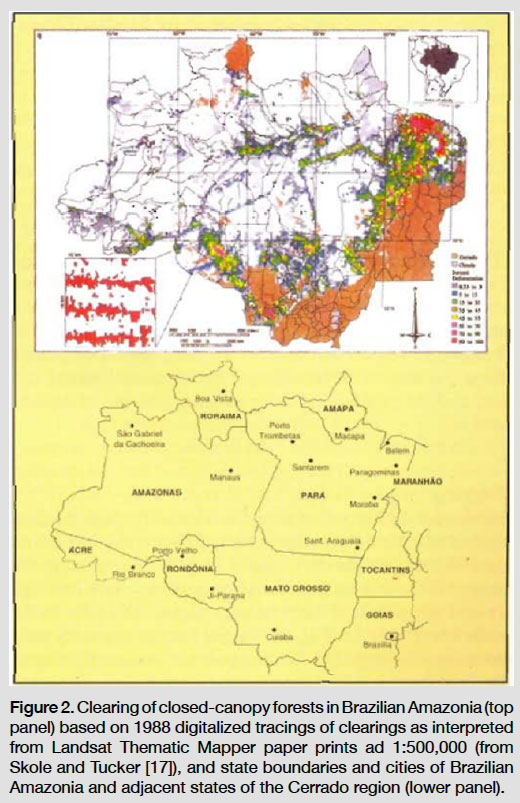
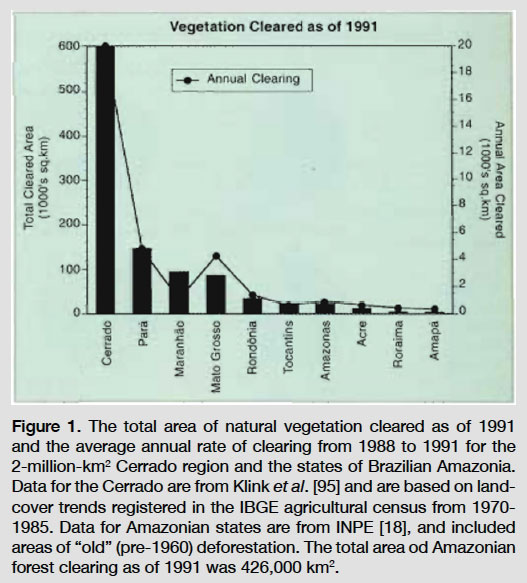
<body><![CDATA[<p><font size="2" face="Verdana, Arial, Helvetica, sans-serif">Just to the south and east of Amazonia, the giant Brazilian Cerrado mosaic of Evergreen woodland species rich Savannah and grassland ecosystems is undergoing a different set of transformations. Extensive grazing of natural grasslands is giving way to cattle production on planted pastures, while the well structure oxisols of the region are tilled and fertilized for the production of soybeans rice and other annual crops. Along with the settlement of the Cerrado has come an increase in the frequency of fires that may have changed the structure and function of Cerrado visitation in ways that are difficult to measure &#91;13-16&#93;.</font></p>     <p><font size="2" face="Verdana, Arial, Helvetica, sans-serif">It is within the context of this complex array of land-uses that the LBA science plan is being formulated. The integrated research programs will study the impact of Amazonian and Cerrado land use on carbon storage trace gas fluxes and nutrient dynamics. But synthesis of the large amount of unpublished and recently published information on land use is needed to inform this planning process and to improve the quality of the proposals and science to follow. In this document we review information on the major forms of land use in their geographical distribution and their probable trends over the next decade. We also discuss these land uses as they relate to the occurrence of El Ni&ntilde;o/ southern oscillation rainfall anomalies and projected reductions in rainfall.</font></p>     <p align="center"><font size="2" face="Verdana, Arial, Helvetica, sans-serif">   <styled-content style="color:#890e10"><b>"People are altering the native ecosystems of Amazonia and the Cerrado region through their efforts to derive sustenance and wealth from agriculture ranching and timber harvest."</b></styled-content>   </font></p>     <p><font size="2" face="Verdana, Arial, Helvetica, sans-serif">The lion's share of research on land use in Amazonia has focused on regions of closed canopy forests, which comprise about 80% of the Brazilian legal Amazon. This review is divided into a large section concerning closed canopy forests of Amazonia, followed by a smaller section concerning the savanna-like, Cerrado vegetation.</font></p>     <p>&nbsp;</p>     <p><font size="3" face="Verdana, Arial, Helvetica, sans-serif"><b>Closed canopy forests</b></font></p>     <p><font size="2" face="Verdana, Arial, Helvetica, sans-serif"><i><b>Spatial and temporal patterns of deforestation</b></i></font></p>     <p><font size="2" face="Verdana, Arial, Helvetica, sans-serif">The conversion of closed canopy forests to pasture and cropland can be mapped using imagery of the Landsat thematic mapper satellite. Unlike the Cerrado biome of Brazil, the closed canopy forests of Brazilian Amazonia have been mapped entirely by different research groups using TM imagery for several time periods &#91;17-19&#93;. A Pan-Amazonian map of deforestation has been prepared using the relatively coarse resolution (16 km pixels) NOAA-AVHRR imagery &#91;20&#93;.</font></p>     <p><font size="2" face="Verdana, Arial, Helvetica, sans-serif">The clearing of closed canopy Amazonian forest has been concentrated in the east and South of the region in the Brazilian states of Par&aacute;, Maranh&atilde;o, Mato Grosso, and Rond&ocirc;nia, in decreasing order (<a href="#fig1">Figure 1</a>, <a href="#fig2">Figure 2</a>) (<a href="/img/revistas/cic/v76n2/a12tab01.jpg">Table 1</a>). The two recent efforts to map deforestation in Brazilian Amazonia using prints of Landsat TM images have yielded remarkably different estimates of the total area cleared in each state. For 1988, the estimate of the total area deforested of Skole and Tucker &#91;17&#93; are lower than those of INPE &#91;18&#93; by 20% (Rond&ocirc;nia), 30% (Mato Grosso), 33% (Acre), 40% (Amazonas), and 50% (Tocantins), but are also quite close for Par&aacute; and Maranh&atilde;o. The lower estimates of Skole and Tucker &#91;17&#93; may be a result of the coarser resolution employed by this group (1:500,000) compared to the resolution employed by INPE (1:250,000) are the fact that Skole and Tucker &#91;17&#93; use it as a single spectral channel compared to three employed by INPE. Whatever the cause, there continued to be large uncertainties associated with this most basic parameter of land use change in Amazonia.</font></p>     <p><a name="fig1"></a></p>     ]]></body>
<body><![CDATA[<p>&nbsp;</p>     <p align="center"><img src="/img/revistas/cic/v76n2/a12fig01.jpg"></p>     <p>&nbsp;</p>     <p><a name="fig2"></a></p>     <p>&nbsp;</p>     <p align="center"><img src="/img/revistas/cic/v76n2/a12fig02.jpg"></p>     <p>&nbsp;</p>     <p><font size="2" face="Verdana, Arial, Helvetica, sans-serif">The rate of clearing of closed canopy Amazonian forests was highest from 1978 to 1988 (21,000 km<sup>2</sup> per year), declined until 1990/91 (11,000 km<sup>2</sup> per year) and then increase it during the period from 1992 to 1994 (15,000 km<sup>2</sup> per year) &#91;17-19&#93; (<a href="/img/revistas/cic/v76n2/a12tab01.jpg">Table 1</a>). This temporal sequence of forest clearing estimates was made using Landsat TM imagery and is the world's best record of deforestation in a large tropical forest region. Forest clearing trends beyond 1994 are not yet published. However, the largest number of Amazon fires detected by the NOAA-AVHRR satellite since 1987 were registered in 1995 &#91;21&#93;, suggesting that forest clearing may have increased further since the last INPE map of deforestation was produced in 1994.</font></p>     <p><font size="2" face="Verdana, Arial, Helvetica, sans-serif"><i>What forest alterations are missed by TM-based analysis?</i></font></p>     <p><font size="2" face="Verdana, Arial, Helvetica, sans-serif">The dichotomous forest versus non-forest approach to mapping land use activities neglects important alterations of the forest that are difficult to measure reliably using Landsat TM imagery. In this section we discussed the problem of quantifying the area of forest affected by selective logging and fire and the problem of understanding the fate of cleared lands.</font></p>     ]]></body>
<body><![CDATA[<p><font size="2" face="Verdana, Arial, Helvetica, sans-serif"><i>Logging</i></font></p>     <p><font size="2" face="Verdana, Arial, Helvetica, sans-serif">More than 4000 km<sup>2</sup> of forest is altered through logging each year in Par&aacute; state alone (see: <i>Logging and mining: the case of Par&aacute; state</i>). This is roughly equivalent to the area of forest that is cleared each year in this state (see <a href="#fig1">Figure 1</a>), and about half of the total area cleared annually in the early 90s &#91;18,19&#93; (see <a href="#fig1">Figure 1</a>). Logged forests frequently burn because of the large fine fuel loads and drier microclimate of the litter layer in logged versus primary forest &#91;6,22&#93;. Estimates of deforestation based on visual inspection of TM print may capture some small portion of the very pronounced logging scars of the most intensive forms of selective logging such as those found within a few km of Paragominas. But even these logging scars disappear from TM scenes whizzing three years time as the logging roads and loading zones are grown over with recovering vegetation &#91;23&#93;.</font></p>     <p><font size="2" face="Verdana, Arial, Helvetica, sans-serif"><i>Fire scars</i></font></p>     <p><font size="2" face="Verdana, Arial, Helvetica, sans-serif">The area of forested or agricultural land that burns each year is one of the most important parameters needed for the LBA science campaign, since burning influences virtually all the ecological processes that the campaign will address. INPE's hot pixel mapping of fires has provided important data on this issue, demonstrating that hundreds of thousands of individual fire events occurred in Amazonia in 1987, for example, representing &gt;200,000 km<sup>2 </sup>&#91;11&#93;. However, these maps of AVHRR pixels that exceeded thermal thresholds are difficult to translate into precise areas of fire scars by vegetation cover type because of problems of pixel saturation by small fires, the prolonged smoldering of woody biomass, and the coarse resolution of the data (1 X 1 pixels) &#91;24, 25&#93;. Forest ground fires are particularly difficult to detect from space.</font></p>     <p><font size="2" face="Verdana, Arial, Helvetica, sans-serif">Pereira and Setzer &#91;26&#93; Have also demonstrated that Landsat TM imagery can be used to detect fire scars in Amazonia on the basis of spectral signatures. Using this approach, Nelson &#91;27&#93; inspected TM print for all of Brazilian Amazonia with ground truthing at several locations and measured &gt; 500 km<sup>2</sup> of burnt primary forest that had undergone crown deaths and another 1,000 km<sup>2</sup> of primary forest that had undergone deleafing from ground fire during the 1983 drought. He predicts that these values greatly underestimate the area of primary forest that burned during this severe El Ni&ntilde;o-related drought.</font></p>     <p><font size="2" face="Verdana, Arial, Helvetica, sans-serif">Using visual interpretation of a 1988 TM image, a 1,000 km<sup>2</sup> fire scar was mapped in an area of mostly logged forest north of Paragominas &#91;28&#93;. This scar was probably not included in the regional deforestation estimates, since it appeared to have substantial forest remaining. However, a site visit revealed that the forest remains visible in the satellite image were actually the crowns of remnant trees persisting in an impoverished forest. Local landholders stated that portions of this forest had burned three times &#91;29&#93;. The area of the single scar represented ~5% of the 1988 estimate of forest clearing. In another forest ground fire observed in Paragominas, 45% of all trees &gt;10 cm diameter at breast high were killed &#91;30&#93;. Forest ground fires are difficult to map using Landsat TM imagery but assert a profound influence on forest structure and function.</font></p>     <p><font size="2" face="Verdana, Arial, Helvetica, sans-serif">The fire scar near Paragominas underscores the important interaction between logging and forest flammability. By opening the forest canopy and increasing the fine fuel load on the forest floor, logging greatly increases the risk that the forest will experience ground fires that are initiated in adjacent agricultural lands &#91;6, 22&#93;.</font></p>     <p><font size="2" face="Verdana, Arial, Helvetica, sans-serif">The frequency of fire may increase in the future through positive feedback with regional climate change. The reduction in rainfall predicted by most modeling experiments done thus far (e.g., references 21, 32 and 33, but not predicted by Polcher and Laval &#91;34&#93;), may exacerbate drought induced forest burning which in turn may lead to less evapotranspiration, less rainfall and more fire &#91;4&#93;.</font></p>     <p><font size="2" face="Verdana, Arial, Helvetica, sans-serif"><i>The fate of cleared land</i></font></p>     <p><font size="2" face="Verdana, Arial, Helvetica, sans-serif">By 1994, about 470,000 km<sup>2</sup> of Brazilian Amazonian forest had been cleared and replaced with managed (disk-tilled fertilized and replanted) pastures of African forest grasses, "degraded" pastures that have large amounts of shrubs and non forage herbs, fields of animal crops, perennial crops, and re-growing forests on abandoned pasture and cropland &#91;18&#93;. Knowledge of the aerial extent of each of these vegetation types is important because they vary greatly in the amount of carbon they store or sequester from the atmosphere in their patterns of runoff and evapotranspiration and in their patterns of trace gas flux &#91;1, 3, 4, 35-49&#93;.</font></p>     ]]></body>
<body><![CDATA[<p><font size="2" face="Verdana, Arial, Helvetica, sans-serif">In the absence of Amazonian wide analysis of the aerial coverage of different anthropogenic ecosystem, we can turn to case studies for an understanding of the current distribution and temporal trends of these lands cover types. The Bragantine zone, east of Bel&eacute;m, is the oldest agricultural frontier in Amazonia and provides a glimpse into the future of Amazonian landscapes that are currently dominated by small holder farmers and close to markets. Although this region is characterized as "old deforestation" by the Amazonian-wide efforts to map deforestation &#91;17-19&#93;, analysis of Landsat TM scenes and field studies in three Bragantine counties reveal that land use in this region is quite dynamic. After nearly a century of agriculture, primary forest had been reduced to 15% of the landscape and was concentrated along streams on sites where agriculture was unviable. Old secondary forests (more than 20 years) comprised only 23% of the area. Those portions of the landscape that are still in use by farmers including young secondary "fallow" forests (29%), pastures (13%), and agricultural crops (9%) made-up half of the land area &#91;49&#93; (<a href="#fig3">Figure 3</a>).</font></p>     <p><a name="fig3"></a></p>     <p>&nbsp;</p>     <p align="center"><img src="/img/revistas/cic/v76n2/a12fig03.jpg"></p>     <p>&nbsp;</p>     <p><font size="2" face="Verdana, Arial, Helvetica, sans-serif">In a similar change detection study conducted near the town of Altamira &#91;50&#93; a 25-year-old frontier that was initiated as a colonization project, 2/3 of the forest was remaining and 1/4 of the landscape was covered by pasture, crop fields and young secondary forests &#91;51&#93; (<a href="#fig3">Figure 3</a>). In this region, the total area in pastures and croplands declined slightly during the six-year study period, but the portion of this area in young secondary forests increased by 8%. This region does not have good highway connections with major urban centers and may be undergoing a process of agricultural stagnation.</font></p>     <p><font size="2" face="Verdana, Arial, Helvetica, sans-serif">During a three-year period in Paragominas one of the centers of the large government subsided ranches implanted during the 1970s, the area of forest declined by 4% and the area of pasture and cropland declined by 6% (see <a href="#fig3">figure 3</a>). Paragominas contrary to Altamira, has excellent highway links with Bel&eacute;m, and has the highest concentration of sawmills in Amazonia. The reduction in area of active pasture and cropland in this region may be a result of the intensification of cattle production on smaller areas of pasture.</font></p>     <p><font size="2" face="Verdana, Arial, Helvetica, sans-serif">In Paragominas and Altamira "forest" what's the most common type of land cover after 25 years of agricultural settlement, but had been reduced to the margins of streams after 90 years of settlement in the Bragantine region. The "forest" category includes those forests that had been logged or that had experienced ground fires, which could be most of the forest in the case of Paragominas. 66% of the land within a 25 km radius of Paragominas still supports forest cover, but only 6% of this land supports forest that has been neither logged nor burned &#91;52&#93;. In Altamira and Paragominas there appears to be a trend toward abandonment of pasture and cropland followed by second forest regrowth such that pastures and croplands occupied less than half of the land originally cleared for agriculture. In Altamira where small-scale farmers are prevalent much of the young secondary forest may be agricultural fallows and hence not truly abandoned. In Paragominas, we're only 4% of the land is occupied by smallholders secondary forests are mostly abandoned pastors that may also come back into production through faster reformation.</font></p>     <p><font size="2" face="Verdana, Arial, Helvetica, sans-serif">These and other studies &#91;1, 36, 54-60&#93; show that phenomenon of land abandonment followed by forest regrowth in Amazonia appears to occur following all but the most intensive forms of pasture management such as those that involve mechanization and/are numerous cycles of burning herbicide application and overgrazing. Where pasture management has depleted soil seed banks of tree species killed the residual tree roots that can give rise to new shoots through sprouting and introduce it populations of seed and seedling consuming ants and rodents the reestablish moment of tree cover following pasture abandonment can take &gt;5 years and longer if these sites burn periodically &#91;5359&#93;.</font></p>     <p><font size="2" face="Verdana, Arial, Helvetica, sans-serif">One particularly promising approach to the mapping of secondary vegetation involves the modeling of spectral end members &#91;62, 63&#93;. This approach may also provide a technique for mapping logging and fire scars that are otherwise difficult to see in satellite images. It isn't clear if this approach would allow for the satellite-based classification of secondary forests by age biomass or species composition over large areas of Amazonia, since the floristic composition of secondary forests is highly variable from one region to the next.</font></p>     ]]></body>
<body><![CDATA[<p>&nbsp;</p>     <p><font size="3" face="Verdana, Arial, Helvetica, sans-serif"><b>The macro causes off deforestation</b></font></p>     <p><font size="2" face="Verdana, Arial, Helvetica, sans-serif">This facial pattern of forest clearing in Brazilian Amazonia has closely tracked the construction of highways. The Bel&eacute;m-Par&aacute; highway (BR-010) in eastern Par&aacute; and Maranh&atilde;o, the BR-364 in Mato Grosso, Rond&ocirc;nia, and Acre, the Transamazon Highway in central Par&aacute; and Amazonas, and the PA-150 in East Central Par&aacute; (see <a href="#fig2">Figure 2</a>) have all become corridors for human settlement and forest conversion in rural Amazonia. In tandem with highway construction, government programs have provided land are fiscal incentives for agriculture, leading to focal points of settlement and forest conversion. For example, much of the "old deforestation" east of Bel&eacute;m and Maranh&atilde;o occurred near the turn of the century through agricultural clearing by immigrants from Brazil's drought stricken Northeast, who were provided land in the region through a government settlement program &#91;62&#93;. In the 1970s, The Brazilian government's program to promote faster establishment resulted in clearing along the Bel&eacute;m-Bras&iacute;lia highway in eastern Par&aacute;, giving rise to towns such as Paragominas &#91;63, 64&#93;. Numerous colonization programs in all states of the region but particularly in Mato Grosso, Par&aacute;, and Rond&ocirc;nia led to clearing by landless immigrants that were put to the region by these programs and pushed from their land in southern and northeastern Brazil by industrial agriculture and drought &#91;56, 64, 65, 66, 67&#93;. In recent years, government subsidized programs to promote the colonization of rough areas of pristine forest have declined. Land is still being distributed by government agencies, but direct financial incentives to clear forest have dried up. FNO (<i>Fundo Constitucional do Norte</i>), which is the major government credit program for Amazonian farmers and ranchers, provides funds for agricultural recuperation of lands that are already cleared but not for new clearing.</font></p>     <p><font size="2" face="Verdana, Arial, Helvetica, sans-serif">Forest clearing also occurs where it is not planned. Expanding agricultural frontiers can be found around the Manaus's free trade zone, near Santar&eacute;m, Par&aacute; and Cuiab&aacute;. The railroad corridor of the Caraj&aacute;s iron mine has fostered forest clearing and charcoal production that was not anticipated in the mine's development plan &#91;68, 69&#93;. The potential for unplanned spontaneous forest clearing may increase greatly in the future as industrial mines provide new foci of employment and forest access roads to Brazil's land seeking citizens. For example a $160 million loan was recently approved by the World Bank (international finance corporation) to finance a kaolin mine in northeastern Par&aacute; that would provide 7% of the world's supply of this clay mineral, and that will include access roads, a 180 km pipeline and employment for 5000 laborers &#91;12&#93;. Dozens of similar mining operations are nearing the end of the licensing process. Information on the spatial distribution of new industrial mines allow us to identify those regions that should have the greatest changes in access to forested regions and where opportunities for employment and land acquisition will rise for the landless poor. Most new mining operations are currently being planned for western and Southern Par&aacute;, northern Amazonas and Rond&ocirc;nia states, but the availability of electricity may encourage more mining in southern Par&aacute;  (see: <i>Logging and mining: the case of Par&aacute; state</i>).</font></p>     <p>&nbsp;</p>     <p><font size="3" face="Verdana, Arial, Helvetica, sans-serif"><b>The proximate causes of deforestation</b></font></p>     <p><font size="2" face="Verdana, Arial, Helvetica, sans-serif">People clear Amazonian forest as the first step in pasture formation and crop field preparation. The biomass of the felled forest is allowed to dry and then burn it, providing an input of nutrient rich ash to the soil surface. This ash promotes the growth of western forage grasses and crop plants, but this fertilizing effect declines with time, especially in crop fields where weed invasion and declining levels of soil fertility restrict the productive period of recently cleared land to 1-3 years. It is the rapid decline in crop productivity that forces small-scale "slash and burn" farmers to clear more forest.</font></p>     <p><font size="2" face="Verdana, Arial, Helvetica, sans-serif">Although small-scale farmers are numerous, and are dependent upon frequent clearing of forest for their agricultural production, it is the large-scale landholders that appear to be responsible for most forest clearing in Amazonia. Fearnside &#91;70&#93; has analyzed the relative contribution to the forestation of smallholders (lots &lt;100 ha) versus large scale and holders by conducting regression analysis of census data and deforestation estimates for the nine Amazonian states. He estimates that ~30% of forest clearing in 1991 can be attributed to smallholders and 70% to large scale and holders. This is not to say that smallholders do not become large scale and holders as they accumulate land and cattle and as their household labor pool expands.</font></p>     <p><font size="2" face="Verdana, Arial, Helvetica, sans-serif">The logic that leads landholders to farm cattle pastures may have changed in recent years. In the 1970s and early 80s, large scale landholders formed extensive cattle pastures to establish ownership over land and to "capture" the escalating land values and government subsidies &#91;64, 71, 72, 73&#93;. As government subsidies for pastures formation have disappeared and as new cattle pastures management systems have emerged, the logic behind cattle pasture formation appears to have evolved. Cattle pastures are now the best means by which rural Amazonians can accumulate the wealth generated by logging artisanal mining or agriculture - the "so besides from nature" that drives today's Amazonian land use systems &#91;72&#93;. For both large and small scale landholders &#91;74&#93; cattle pastures provide only a small profit margin (last then $10/ha/yr) using the traditional extensive model of pasture management &#91;75&#93;, but investments in pasture are highly liquid compared to investments in perennial crops or forest management for timber. The price of beef is more stable than other agricultural products and the market for cattle is a ubiquitous, such that the bovine that becomes a form of alternative currency on the agricultural frontier. Cattle pastures therefore represent an inflation free, liquid investment that strengthens legal claims to land. In addition, the current rate of pasture formation may reflect demographic phenomena interacting with economic conditions at the household level, promoting widespread shifts to investment crops from production based on annual crops &#91;76,77&#93;.</font></p>     <p><font size="2" face="Verdana, Arial, Helvetica, sans-serif">An unimportant factor making Amazon ranching an attractive land use is the low price of land compared to the traditional ranching regions in central and South Brazil. Land prices have increased dramatically in central and South Brazil due to the increased cultivation of agricultural export crops (e.g., soybeans). The mainland price for agricultural pasture land in the states of S&atilde;o Paulo, Minas Gerais and Goi&aacute;s (place of origin of the majority of Par&aacute; ranchers) was 3.6 times greater than in Par&aacute; in the early 1990s, $1,541 versus $427, lowland prices and therefore lower costs of capital explain why eastern Amazonia ranchers can compete in the national market for meat even though they are far from consumer markets &#91;75&#93;.</font></p>     ]]></body>
<body><![CDATA[<p><font size="2" face="Verdana, Arial, Helvetica, sans-serif">The logic behind pastor formation continues to evolve. The future of Amazonian cattle ranching may be found in regions such as Paragominas a ranching and logging center of eastern Amazonia were semi intensive cattle pasture systems involving disking fertilization and new types of forage grasses (especially <i>Brachiaria brizantha</i>) generate average annual profits of $50/ha &#91;78&#93;. In this same region, even greater profits are generated by small-scale dairy production systems does not generally involve new forest clearing in the Paragominas region.</font></p>     <p><font size="2" face="Verdana, Arial, Helvetica, sans-serif">Other land cover dynamics are also in evidence. Although substantial concern has focused on pasture formation (given ecological impacts) some deforestation leads to the adoption of perennial crops, which is a form of agricultural intensification. This is an important process from the perspective of achieving sustainable development &#91;79&#93;.</font></p>     <p><font size="2" face="Verdana, Arial, Helvetica, sans-serif">Hence, in the place of government loans and subsidies the major source of capital driving expansion of the agricultural frontier today may be timber and minerals &#91;65, 78, 80&#93; with cattle pastures acting as a form of "savings account". The trajectory of new clearing is tied to the geographical distribution of logging gold mining and industrial mining, as we illustrate here with a review of logging ranching and mining in the state of Par&aacute;.</font></p>     <p>&nbsp;</p>     <p><font size="3" face="Verdana, Arial, Helvetica, sans-serif"><b>Logging and mining: the case of Par&aacute; state</b></font></p>     <p><font size="2" face="Verdana, Arial, Helvetica, sans-serif">The state of Par&aacute; (see <a href="#fig2">Figure 2</a>) is the source of 80% of the timber harvested from Brazilian Amazonia. Hence, most of the Amazonian timber industry can be understood through analysis of logging in this eastern Amazonian state.</font></p>     <p><font size="2" face="Verdana, Arial, Helvetica, sans-serif">Today most timber is extracted at low intensity over large areas of forest. This "extensive" system is characterized by extraction of only high value species with little planning of logging roads and skid trails. The deflation of forest timber stocks is seen in parts of the estuary region of the Amazon River where logging has been going on for centuries &#91;81&#93;.</font></p>     <p><font size="2" face="Verdana, Arial, Helvetica, sans-serif">More recently, there has been a trend toward more intensive logging in old frontier areas along the Bel&eacute;m-Bras&iacute;lia highway. Here, 100 or more species are harvested, and significant damage is inflicted on the canopy and ground surface through tree felling and log extraction. Forest leaf canopy cover decreases 50% and up to half of the forestry basal area is lost through direct harvesting toppling or damage &#91;80&#93;. Unfortunately, this more aggressive harvesting has not being accompanied by measures to guarantee future harvests. Unless forest management methods are implemented, timber extraction in Par&aacute; may have a short life span. Forest management is not utilized in most areas of Par&aacute;.</font></p>     <p><font size="2" face="Verdana, Arial, Helvetica, sans-serif">It is tempting to describe the wood industry in the Brazilian Amazon using summary statistics and averages, but this approach provides only a limited amount of information about the sector. There are very few central tendencies in this industry, but there are some patterns that can be detected. Five factors influence the characteristics of the wood industry: 1) local extent composition (especially the presence of high value species); 2) transport options (fluvial versus terrestrial); 3) availability of investment capital; 4) market options (domestic versus export); and 5) local social cultural traditions. The role of these factors is evident in Par&aacute; state, where most logging activities in the Brazilian Amazon are concentrated. We have identified five models of logging in this state - two in "v&aacute;rzea" (floodplain) Forests and three in the "terra firma" (upland) forests &#91;80-83&#93;. In considering the impact of logging on carbon stocks nutrient cycling and so forth, it will be important to design research that incorporates the different intensities of logging that are found in Amazonia.</font></p>     <p><font size="2" face="Verdana, Arial, Helvetica, sans-serif">Amazonian logging is emerging as a major growth industry. At present, the logging industry in Par&aacute; harvests some 8.3 million m<sup>3</sup> of round wood/ear (IMAZON database). Considering that, on average, 20 m<sup>3</sup> a forest are logged in Par&aacute; state each year. But the wood sector is not static. The Brazilian economy is projected to grow at 7% in the period marking the transition from the 20<sup>th</sup> to the 21<sup>st</sup> century. If this occurs and if the Amazon would industry experience, the same level of gross wood production will double to 16,000,000 m3/yr in 10 years. In this case the area of forest logged each year would be approximately 8000 km<sup>2</sup>. Assuming a cutting cycle of 70 years in the absence of forest management &#91;84&#93; the total area of the state of Par&aacute; needed to double present day round wood production (i.e., supply 16,000,000 m<sup>3</sup> of hardwood per year) on a sustainable basis would be about 560,000 km<sup>2</sup> (8,000 km<sup>2</sup> X 70-year cutting cycle) or half the area of the state. Of course, if production were to double over the next 10 years, it is unlikely that it would then suddenly stabilize. If the projected 7% annual growth in timber production continued for an additional 10 years, we calculate that the annual production would have exceeded a level beyond what could be sustained given the available area. Therefore, although the impacts of this activity are relatively small now, increasingly it is the drive for wood that will be a catalyst determining how Amazonia is occupied and the associated impacts.</font></p>     ]]></body>
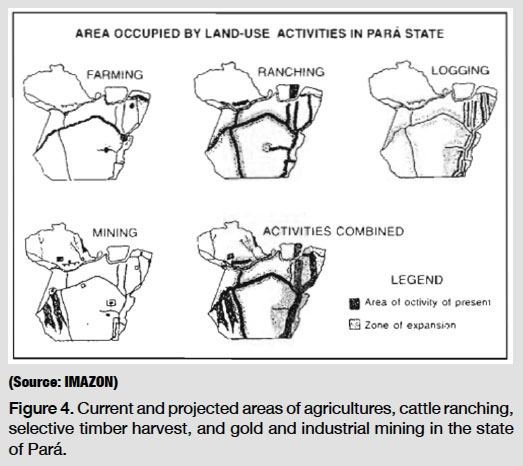
<body><![CDATA[<p><font size="2" face="Verdana, Arial, Helvetica, sans-serif">There are two additional logging related topics that merit special attention. The first is vines. The long-term sustainability of a logging economy in Amazonia may be severely jeopardized by vines. This plant group is favored by gaps of debris and stem cutting (vigorous sprouters) - the very disturbances that logging promotes. Vine cutting conducted in conjunction with forest management may have an effect on regional rainfall. Vines often have root systems that extend deep into the soil (10 meters or more) and therefore vines might be responsible for a significant fraction of forest evapotranspiration during dry periods &#91;85&#93;. The removal of vines from the forests of eastern Amazonia may reduce evapotranspiration, with concomitant effects on regional rainfall.</font></p>     <p><font size="2" face="Verdana, Arial, Helvetica, sans-serif">Finally, just as forest management could affect the original landscape, so two changes in the original landscape might affect forestry. Particularly worrisome for sustainable forestry is the process of forest fragmentation. As forested landscapes become more fragmented there may be reductions in pollinator services provided by birds and insects the incidence of seeds and seedling predation might increase fire and wind through disturbances may become much more common and the movement patterns of large carnivores that could exert important ecosystem control functions might be impacted. These landscape level processes and feedbacks are poorly understood and merit study as they are likely to be important in the maintenance of healthy forests.</font></p>     <p><font size="2" face="Verdana, Arial, Helvetica, sans-serif">The state of Par&aacute; also has more mineral extraction than any other state in Brazilian Amazonia.</font></p>     <p><font size="2" face="Verdana, Arial, Helvetica, sans-serif">Gold mining is the most common extensive style mining approach in Par&aacute;. There has been considerable environmental damage as a result of gold mining. Mercury contaminates waterways and streams because clouded with silt dislodged when riverbanks are dismantled by water hoses. Only a small fraction of the gold in the deposits is actually recovered (see references 5 for an overview and 7, 8, 9).</font></p>     <p><font size="2" face="Verdana, Arial, Helvetica, sans-serif">Industrial mining also occurs in Par&aacute;. The best example is iron or extraction in the Caraj&aacute;s Mine in southern Par&aacute;. Industrial mining is of special concern to the Amazon science plan as a predictor of future patterns of forest clearing. The opening of new mines in southern Par&aacute; where electricity is available and licenses to mine have been solicited could lead to deforestation zones similar to those found along the Caraj&aacute;s railway corridor. Mines that are located on rivers and that transport their product by barge or pipeline have the potential to increase the sediment load and to introduce toxins into these rivers.</font></p>     <p><font size="2" face="Verdana, Arial, Helvetica, sans-serif">Gold mining is far more pervasive than industrial mining at the present, and maybe influencing more river systems. Although the release of mercury into river systems through gold mining has been fairly well documented, the effects of mining on stream sediment loads string chemistry fisheries and forests that surround mining camps have not been described in detail. An understanding of land use effects on Amazonian surface waters will require field studies of this widespread form of mining.</font></p>     <p>&nbsp;</p>     <p><font size="3" face="Verdana, Arial, Helvetica, sans-serif"><b>Future trends</b></font></p>     <p><font size="2" face="Verdana, Arial, Helvetica, sans-serif">The present spatial distribution of resort extraction activities determines in large part the future pattern of human occupation. In the case of Par&aacute;, the maps provided in <a href="#fig4">Figure 4</a> show that farming ranching and logging activities are linked to established road networks. The areas bordering roads to a distance of 5 to 50 km have been cleared and are used mainly for ranching. In the proximity of towns, roadside land is frequently devoted to agriculture. Logging activities are practiced behind the ranches to a distance of 50 to 100 kilometers. Where would have exceptionally high value (e.g., mahogany) is involved, loggers may go as far as 500 kilometers from the mill to insert of logs &#91;82&#93;. In these cases, they actually build the roads themselves.</font></p>     <p><a name="fig4"></a></p>     ]]></body>
<body><![CDATA[<p>&nbsp;</p>     <p align="center"><img src="/img/revistas/cic/v76n2/a12fig04.jpg"></p>     <p>&nbsp;</p>     <p><font size="2" face="Verdana, Arial, Helvetica, sans-serif">At present only about 10% of the state has been affected by these resource use activities, but this is changing rapidly. Expansion trends for the next several decades will likely result in the occupation of 40% to 50% of the state (<a href="#fig4">Figure 4</a>). Industrial growth will continue spreading into western Par&aacute; including the varzea areas; while southern Par&aacute;, an area already is covered with many roads, will experience increasing pressure from logging agriculture and mining activities. Logging and mining are likely to be the dominant activities and deserve special mention.</font></p>     <p><font size="2" face="Verdana, Arial, Helvetica, sans-serif">Logging currently provides the second largest income generating activity for the state. Tropical timber resources continue to enjoy a warm reception on both the national and world markets. Philippine and Malaysian buyers now regularly visit Bel&eacute;m and other wood processing centers such as Paragominas and Marab&aacute;. Stocks are valuable mahogany in southern Par&aacute; are likely to be depleted before the end of the present century. At the same time, lesser value timber will increasingly be extracted to feed the many sawmills already established along the roadways and in urban centers throughout southern Par&aacute; and the Transamazon highway. There is no sign of sustainable logging practices in the region. Moreover, if unchecked the secondary effects of logging which include spontaneous colonization along logging roads and forest fire could foreclose the possibility of future cuts.</font></p>     <p><font size="2" face="Verdana, Arial, Helvetica, sans-serif">Mining has been and will continue to be a key activity in Par&aacute; over the next several decades. Between 1975 and 1987 mineral production grew from 0.1% to 7.0% of the state's internal production. It currently represents the largest income generating activity for the state and continues to grow in the 1990s. Today nearly 2,800 permits to search for mineral resources hold claim to 16% of the state (120,000 km<sup>2</sup>), but only a small fraction of the area is being actively exploited. The major limitation to expanding activities in formal mineral extraction is the activities' dependence on electricity. In southeastern Par&aacute;, blessed with electrical power supplies and roads, mineral extraction activities will continue to expand in both the industrial and the gold mining sectors. Southwestern Par&aacute;, it's less developed today, but plans exist to build roads and provide electricity in the near future. Although much mineral prospecting has been conducted in northern Par&aacute;, the lack of power lines makes extensive mineral extraction activities unlikely in the near future.</font></p>     <p><font size="2" face="Verdana, Arial, Helvetica, sans-serif">As Par&aacute;'s natural resources become exhausted, urban migration poverty and ecological stress increase. In 1991 Par&aacute;'s urban population accounted for more than 50% of the state's approximate 5 million people &#91;86&#93;. This is the first time that urban populations are larger than rural populations in the state. As a reflection of this growth, populations in urban centers in Par&aacute; have more than doubled in the past 15 years.</font></p>     <p>&nbsp;</p>     <p><font size="3" face="Verdana, Arial, Helvetica, sans-serif"><b>Government colonization projects: the case of Rond&ocirc;nia state hence</b></font></p>     <p><font size="2" face="Verdana, Arial, Helvetica, sans-serif">Land-use in the state of Rond&ocirc;nia (see <a href="#fig2">Figure 2</a>) has been dominated by large government sponsored projects designed to encourage farmers to settle in forested regions and more recently designed to fix the problems that arose from these settlements schemes. Colonization programs in Rond&ocirc;nia started in the early 70s and successfully attracted thousands of families, mostly from southern Brazil &#91;56&#93;. The first wave of settlers were given forest plots situated on good soils, and the news quickly spread that Rond&ocirc;nia was a land of rich soils. However, only one force of the state is suitable for agriculture, and many of the subsequent farmer colonists achieved only low levels of agricultural productivity compared to the first wave of settlers. The massive influx of colonists led to very high rates of deforestation. From 1978 to 1993 the area of cleared forest in Rond&ocirc;nia went from 4,000 km<sup>2</sup> to 40,000 km<sup>2</sup> (17% of the state territory) as newly arrived farmers cleared and burned the forest to prepare the soil for agriculture &#91;17, 18, 19, 87&#93; (see <a href="/img/revistas/cic/v76n2/a12tab01.jpg">Table 1</a>).</font></p>     ]]></body>
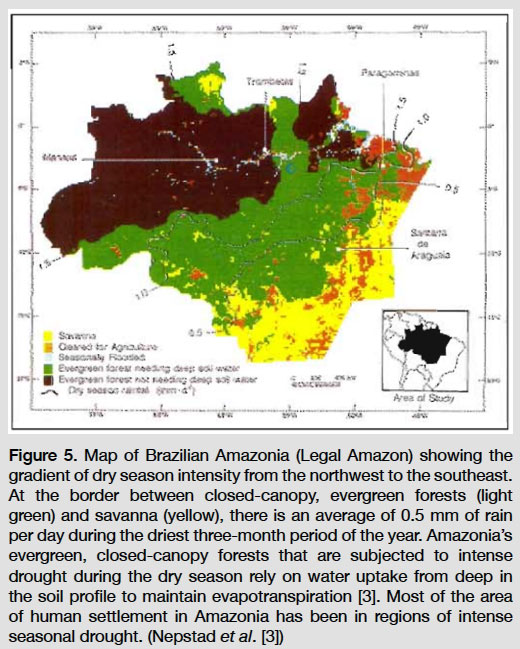
<body><![CDATA[<p><font size="2" face="Verdana, Arial, Helvetica, sans-serif">The plans for the rural sector of Rond&ocirc;nia developed in the 70s included governmental incentives for the planting of animal and perennial crops. However, the trajectory of Rond&ocirc;nia agriculture has now converged with that of other agricultural frontiers in Amazonia in that cattle pasture is the most common use of cleared lands &#91;88&#93; (<a href="/img/revistas/cic/v76n2/a12tab02.jpg">Table 2</a>). Rond&ocirc;nia farmers turned to kettle pasture for the reasons cited above (see: <i>Proximate causes of deforestation</i>) but may also have an added incentive in the substantial infrastructure for the sale and processing of beef and milk. In 1994 the state of Rond&ocirc;nia had 13 dairy units and five slaughterhouses &#91;89&#93;. The arrival in 1994 of a single milk producer in Ouro Preto do Oeste (Parmalat) increased the price paid to farmers for milk by 50%.</font></p>     <p><font size="2" face="Verdana, Arial, Helvetica, sans-serif">Hence, after a little more than two decades Rond&ocirc;nia has become a clear example of the potential for poorly planned settlement schemes in tropical forest regions to promote rapid and extensive losses of tropical forest while providing little improvement in the lives of those people that the schemes were designed to help. In an effort to mitigate some of these ill effects on Rond&ocirc;nia's settlement schemes, the government of Rond&ocirc;nia with support from the World Bank has now launched a new program of agro-ecological zoning of the state in an attempt to control the unregulated expansion of agriculture and logging in the region. This program called PLANAFLORO is also intended to improve the state's rural infrastructure to provide credit for small farmers to demarcate and create extractive reserves and to communities of Amerindians. The performance of this ambitious zoning program should provide valuable lessons about the potential for this approach to rural land use planning to direct the course of rural development in Amazonia.</font></p>     <p>&nbsp;</p>     <p><font size="3" face="Verdana, Arial, Helvetica, sans-serif"><b>Emerging frontiers: the case of Acre state</b></font></p>     <p><font size="2" face="Verdana, Arial, Helvetica, sans-serif">Acre state in western Amazonia is symbolic of regions of "incipient" frontier expansion. While Acre was linked to the rest of Brazil only by an unpaved two-lane highway (BR-364) the influx of settlers to the region and the associated forest clearing were slow. As of 1994 only 12,000 km<sup>2</sup> (80% of the state territory) had been cleared &#91;18, 19&#93;. Acre has now been selected however as the "gateway to the Pacific"; an all weather Rd. may connect to Brazil to the Peruvian seacoast via Acre in the coming years. Hence, Acre represents an opportunity to accompany the process of rural colonization and frontier expansion at an early stage.</font></p>     <p><font size="2" face="Verdana, Arial, Helvetica, sans-serif">Acre also contains some of Amazonia's most important experiments in land use categories, designed to reconcile the rural economic development and forest conservation. Two of the largest extractive reserves in Amazonia, the Chico Mendes (one million ha &#91;1&#93;) and upper Jurua (about 500,000 ha) are located in Acre. These reserves allow the communities of rubber tappers in Brazil not harvesters that live within the boundaries together forest products and practice shifting cultivation while placing constraints on the amount of forest that can be converted to agriculture.</font></p>     <p>&nbsp;</p>     <p><font size="3" face="Verdana, Arial, Helvetica, sans-serif"><b>The climatic stratification of research in Amazonia</b></font></p>     <p><font size="2" face="Verdana, Arial, Helvetica, sans-serif">Virtually all the ecosystems processes that will be studied by the LBA campaign are affected by rainfall regime. Seasonal and interannual drought influences net primary productivity, evapotranspiration runoff and stream flow nutrient export and soil microbial processes. The research design of the campaign should be stratified to include gradients of rainfall seasonality and interannual variability.</font></p>     <p><font size="2" face="Verdana, Arial, Helvetica, sans-serif">Both total rainfall and rainfall seasonality vary from a general gradient that runs from northwestern Amazonia (high ring and seasonal) to southeastern Amazonia (low rank and seasonal). In S&atilde;o Gabriel de Cachoeira (northwestern Amazonas) annual rainfall is ~4000 mm and &gt;100 mm each month; in Santana de Araguaia add to the transition between closed canopy forests of Amazonia to savanna ecosystems of the Cerrado, annual rainfall is ~1550 mm and there are five months each year with &lt; 50 mm off rain (<a href="#fig5">Figure 5</a>). Forest clearing has been heavily skewed toward these areas of seasonal drought; the 2 million km<sup>2</sup> of closed canopy forest that have at least three months each year with &lt;50 mm rainfall contained 75% of the forested lands &#91;3&#93;.</font></p>     ]]></body>
<body><![CDATA[<p><a name="fig5"></a></p>     <p>&nbsp;</p>     <p align="center"><img src="/img/revistas/cic/v76n2/a12fig05.jpg"></p>     <p>&nbsp;</p>     <p><font size="2" face="Verdana, Arial, Helvetica, sans-serif">The major source of interannual rainfall variation in Amazonia is the El Ni&ntilde;o/ Southern Oscillation Phenomenon (ENSO) &#91;90, 91&#93;. ENSO leads to greatly reduced rainfall (30% below average) in eastern Amazonia &#91;92&#93;. Based on a model that tracks plant available soil water (PAW) precipitation and the minimum routing depths necessary to supply evapotranspiration, we estimate that the Evergreen forest in this region deplete PAW to soil depths of &gt; 5 m during ENSO events &#91;93&#93;. Field measurements during the 1992 ENSO event found PAW was depleted to &gt; 8 m soil depths at one site near Paragominas &#91;3&#93;.</font></p>     <p><font size="2" face="Verdana, Arial, Helvetica, sans-serif">A second focus of research on the effects of drought on forest function should be the zone of transition between closed canopy forest and savanna vegetation. A general reduction in rainfall could lead to a shift in the position of this transition as drought stressed forests become a more flammable and invaded by grasses &#91;4, 31&#93;. The recent frequent occurrence of ENSO events and the predicted reduction in rainfall for Amazonia &#91;31, 33, 94&#93; point to the need to understand forest responses to seasonal and interannual drought.</font></p>     <p>&nbsp;</p>     <p><font size="3" face="Verdana, Arial, Helvetica, sans-serif"><b>Recommendations</b></font></p>     <p><font size="2" face="Verdana, Arial, Helvetica, sans-serif">In sum, TM-base it Amazonia wide analysis of forest clearing are needed as a first order estimate of the general trends in Amazonian land-use. A fuller understanding of the trajectory of Amazonian land-use, however, will require information from other types of study. Land-uses such as selective logging the escape of accidental fires into logged and primary forests and secondary succession on abandoned land can alter the carbon storage nutrient cycling hydrology and the flora and fauna of Amazonian forests but are inadequately detected by thematic mapper based monitoring. Some key information needs that could be addressed by the LBA science campaign for Amazonia include the following:</font></p>     <blockquote>       ]]></body>
<body><![CDATA[<p><font size="2" face="Verdana, Arial, Helvetica, sans-serif">- Mapping of the forestation across Brazilian Amazonia is conducted at 2-3 year intervals by INPE and should be continued. It should be extended to non-Brazilian Amazonia and to the Cerrado region it has never been conducted for all Amazonia using Landsat TM.</font></p>       <p><font size="2" face="Verdana, Arial, Helvetica, sans-serif">- Mapping of the expanding frontier of selective logging classified according to logging intensity. The search would require information on the spatial distribution of sawmills their production rates and their harvest intensities, and might draw on rather and high resolution aircraft-mounted sensors.</font></p>       <p><font size="2" face="Verdana, Arial, Helvetica, sans-serif">- Mapping of fire scars. Such an effort might require high resolution mapping (perhaps from aircraft) with ground truthing over sample landscapes. Forest ground fires are particularly difficult to map and may be affecting a large area of logged and primary forests. Moreover, a mechanistic understanding of the role of drought and land-use practices is needed to better project the future importance of forest fires.</font></p>       <p><font size="2" face="Verdana, Arial, Helvetica, sans-serif">- Modeling of secondary forest dynamics. Information is needed on the rates at which agricultural land is abandoned to secondary forest regrowth and the amount of time that passes before this secondary forests are brought back into production through new clearing. This information will probably require a combination of remote sensing studies in combination with ground surveys that characterized the land use strategies adopted by farmers and ranchers. Measurements of secondary forest biomass from space using radar, for example would greatly facilitate this research effort. Such studies should be conducted by multidisciplinary teams that can couple empirical measures of land cover change with socioeconomic studies that reveal the logic of the land managers that are causing this change.</font></p>       <p><font size="2" face="Verdana, Arial, Helvetica, sans-serif">- The design of the LBA campaign should take into consideration the spatial distribution of rainfall with and without ENSO events.</font></p> </blockquote>     <p>&nbsp;</p>     <p><font size="3" face="Verdana, Arial, Helvetica, sans-serif"><b>Cerrado vegetation</b></font></p>     <p><font size="2" face="Verdana, Arial, Helvetica, sans-serif">The legal Amazon of Brazil contains 850,000 km<sup>2</sup> of Cerrado vegetation, concentrated in the states of Mato Grosso (43%) and Tocantins (29%) &#91;17&#93; (see <a href="#fig2">Figure 2</a>). This vegetation is conspicuously absent from the efforts to map deforestation in Amazonia, even though the Tocantins and Xingu reverse find their headwaters in this biome. The effects of land-use on these large rivers have not being studied, even though the aerial extent of native vegetation clearing appears to be larger in these drainage basins than anywhere else in legal Amazonia. Taking as a whole, the Cerrado biome is the second largest of Brazil after the Amazon rainforest representing 22% of the country are approximately 2 million km<sup>2</sup>. It is a tropical seasonal savanna with a continuous layer of herbaceous species (mainly C4 grasses) at the peak of the vegetation grows with scattered shrubs and trees that sometimes form a continuous canopy. It has a characteristic flora, which distinguishes it from other Brazilian biomes, such as the Amazonian and coastal rainforests or the northwestern dryland "caatingas".</font></p>     <p><font size="2" face="Verdana, Arial, Helvetica, sans-serif">A mechanistic understanding of the role of drought and land-use practices is needed to better project the future importance of forest fires."</font></p>     <p><font size="2" face="Verdana, Arial, Helvetica, sans-serif">Savanna transformation through land use is difficult to quantify using a dichotomous TM-based approach because the spectral differences between natural and agricultural vegetation are subtler than enclosed forest regions. Moreover, there is some debate regarding the "original" Cerrado vegetation: was it closed canopy woodland (<i>cerrad&atilde;o</i>) that has disappeared through the increased frequency of fire or was it primarily open savanna (Cerrado strictu senso)? There has nonetheless been progress in mapping the land cover of the region. EMBRAPA-CPAC has mapped the land cover (native vegetation, pastures, cropland) of Goi&aacute;s (which surrounds Bras&iacute;lia) and southern Maranh&atilde;o using Landsat TM imagery in ground truthing. Cerrado regions in Mato Grosso, Tocantins, and Minas Gerais have not been mapped. The estimate of native vegetation clearing presented in <a href="#fig6">figure 6</a> and table one were based on agricultural census data &#91;95&#93;. Further mapping on land cover in the Cerrado is needed.</font></p>     ]]></body>
<body><![CDATA[<p><a name="fig6"></a></p>     <p>&nbsp;</p>     <p align="center"><img src="/img/revistas/cic/v76n2/a12fig06.jpg"></p>     <p>&nbsp;</p>     <p><font size="2" face="Verdana, Arial, Helvetica, sans-serif">The lack of TM-basic maps of land use patterns in the Cerrado region has perhaps masked the considerable importance of this region for the questions posed by the LBA campaign. The aerial extent of pasture and cropland in the Cerrado is greater than that of Amazonian (<a href="#fig1">Figures 1</a> and <a href="#fig6">6</a>) with large but poorly understood implications for the flux of methane nitric and nitrous oxide, CO<sub>2</sub>, in water vapor to the atmosphere &#91;96, 97, 98&#93;.</font></p>     <p><font size="2" face="Verdana, Arial, Helvetica, sans-serif">Cerrado has one of the richest savanna floras in the world. According to Heringer <i>et al.</i> &#91;99&#93; of the 774 woody species, 429 composed the proper floristic stock of the Cerrado, 300 species belong to the forest formations and the remaining 45 to other vegetation types. This number of the 429 unique woody savanna species is not matched by any other savanna flora in the world. The number of herbaceous species is still unknown.</font></p>     <p>&nbsp;</p>     <p><font size="3" face="Verdana, Arial, Helvetica, sans-serif"><b>Cerrado occupation</b></font></p>     <p><font size="2" face="Verdana, Arial, Helvetica, sans-serif">Cerrado exploitation started with the Portuguese searching for precious minerals and Indians for slave amend in the 16<sup>th</sup> century. The first permanent settlements were established in the early 18<sup>th</sup> century and were associated with gold mining. Some farming developed among the mining communities, but economic activity shifted to cattle raising with the exhaustion of the mines. A new wave of exploration began in the middle of the 19th century after the Paraguay war and during the 1920-1930 period, stimulated by the coffee boom in S&atilde;o Paulo state &#91;13&#93;.</font></p>     <p><font size="2" face="Verdana, Arial, Helvetica, sans-serif">Two main factors were responsible for the modern occupation of Cerrado. The construction of Bras&iacute;lia, Brazil's new capital, in the late 50s, and the adoption of development policies and investments in infrastructure between 1968 and 1980. The construction of highways allowed the occupation of space and the expansion of commercial agriculture in Cerrado.</font></p>     ]]></body>
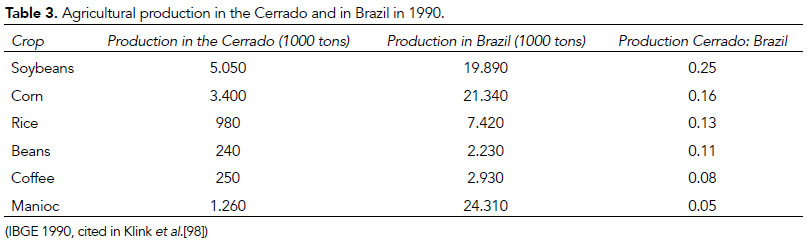
<body><![CDATA[<p><font size="2" face="Verdana, Arial, Helvetica, sans-serif">The policies with the highest impact on agricultural expansion were subsidized credit, tax exemption on agricultural activities, minimum prices for crops, subsidies to fuel, and the development of farming technology suitable to the regions climatic and soil conditions &#91;95&#93;. So besides have favored commercial crops at the expense of staple crops and the environment. Since concession loans were available in the proportion of crop area (not production) they had a dramatic impact on the nature of development and the area cleared &#91;13&#93;.</font></p>     <p><font size="2" face="Verdana, Arial, Helvetica, sans-serif">As a consequence of the expansion of agriculture, total Cerrado population grew from 6.5 million in 1970 to 12.6 million in 1991. Throughout the region, there has been a strong trend towards urbanization and decline of the rural population. Almost a fourth of the population concentrates around the metropolitan areas of Bras&iacute;lia and Goi&acirc;nia, Goi&aacute;s state capital.</font></p>     <p>&nbsp;</p>     <p><font size="3" face="Verdana, Arial, Helvetica, sans-serif"><b>Cerrado land use</b></font></p>     <p><font size="2" face="Verdana, Arial, Helvetica, sans-serif">Until 30 years ago the region was used primarily for extensive cattle rising. Today it is estimated that 37% of this natural vegetation has been transformed into cultivated pastures, crop fields, dams, urban settlements, and degraded areas &#91;15&#93;.</font></p>     <p><font size="2" face="Verdana, Arial, Helvetica, sans-serif">The most significant forms of land use are cultivated pastures and commercial crops mainly soybeans, corn, rice, coffee, beans, and manioc (see <a href="/img/revistas/cic/v76n2/a12tab03.jpg">Table 3</a>). Cerrado production of soybeans in 1994 was 8.8 million tons (1/4 of the national production). Cerrado corn comprises 16% of the national production, rice 13%, coffee 8%, beans 11%, and manioc 5%.</font></p>     <p><font size="2" face="Verdana, Arial, Helvetica, sans-serif">The cattle herd also displayed substantial growth between 1970 and 1985: from 16.6 million to 38 million animals. Cultivated pastures have grown from 8.7 million hectares to 38 million in the same period. The delay in the release of census information makes it difficult to determine cattle growth in recent years.</font></p>     <p><font size="2" face="Verdana, Arial, Helvetica, sans-serif">Projections of the evolution of the main crops, cultivated pastures, and open areas indicate the future of land use in the Cerrado. In 1985, 51 million hectares of land had been cleared in this region. It is estimated that the area of cleared land in 1994 was 70 million hectares, equivalent to 39% of the total area of the region. Considering appropriate conditions for agricultural expansion, good market conditions, and changes in economic policies, the total area of cleared land in the Cerrado will be 88 hectares in 2000, representing 49% of the Cerrado land surface.</font></p>     <p><font size="2" face="Verdana, Arial, Helvetica, sans-serif">The transformation of natural landscapes in the Cerrado it's causing water pollution, soil erosion, fragmentation of vegetation, extinction of wildlife, invasion of exotic species, and modification of the fire regime &#91;13&#93;.</font></p>     <p>&nbsp;</p>     ]]></body>
<body><![CDATA[<p><font size="3" face="Verdana, Arial, Helvetica, sans-serif"><b>Recommendations</b></font></p>     <p><font size="2" face="Verdana, Arial, Helvetica, sans-serif">The lack of information on land-use in the Cerrado biome is remarkable given the amount of attention that the scientific community has given to the closed canopy forest biome of the Amazonia. The LBA science campaign should complete TM-basic mapping of land cover change in that area of the Cerrado Biome that is within or close to the legal Amazon. Similar to the recommendations for the closed canopy forest of Amazonian, information is needed to predict the future geographic trends in Cerrado visitation conversion and the logic that is adopted by the farmers and landholders who manage the vegetation. The science campaign represents an excellent opportunity to analyze the changes that have taken place in this vast biome, much of which drinks through the Amazon estuary, and much of which has already been severely altered by land use practices.</font></p>     <p align="center"><font size="2" face="Verdana, Arial, Helvetica, sans-serif">   <styled-content style="color:#890e10"><b>"The science campaign represents an excellent opportunity to analyze the changes that have taken place in this vast biome"</b></styled-content>   </font></p>     <p>&nbsp;</p>     <p><font size="3" face="Verdana, Arial, Helvetica, sans-serif"><b>References</b></font></p>     <!-- ref --><p><font size="2" face="Verdana, Arial, Helvetica, sans-serif">1. BROWN, I. F.; NEPSTAD, D. C.; PIRES, I.; LUZ, L.; ALECHANDRE, A. Carbon storage and land-use in extractive reserves, Acre, Brazil. <i>Environmental Conservation, </i>Cambridge, v. 19. p. 307-315, 1992.    </font></p>     <!-- ref --><p><font size="2" face="Verdana, Arial, Helvetica, sans-serif">2. NEPSTAD, D. C.; BROWN, I. F.; LUZ, L.; ALECHANDRE, A.; VIRGILIO, V. Biotic impoverishment of Amazon forests by rubber tappers, loggers and cattle ranchers. <i>In</i>: NEPSTAD, D. C.; SCHWARTZMAN, S. <i>Non-timber forest products from tropical trees</i>: evaluation of a conservation and development strategy. New York: The New York Botanical Garden, 1992. p. 1-14.    </font></p>     <!-- ref --><p><font size="2" face="Verdana, Arial, Helvetica, sans-serif">3. NEPSTAD, D. C.; CARVALHO, C. R.; DAVIDSON, E. A.; JIPP, P.; LEFEBVRE, P.; NEGREIROS, G. <i>et al</i>. The role of deep roots in the hydrological and carbon cycles of Amazonian forests and pastures. <i>Nature,</i> London, v. 372, p. 666-669, 1994.    </font></p>     <!-- ref --><p><font size="2" face="Verdana, Arial, Helvetica, sans-serif">4. NEPSTAD, D. C.; JIPP, P.; MOUTINHO, P.; NEGREIROS, G.; VIEIRA, S. Forest recovery following pasture abandonment in Amazonia: canopy seasonality, fire resistance and ants. <i>In</i>: RAPPORT, D. J.; GAUDET, C. L.; CALOW, P. (ed.). <i>Evaluating and monitoring the health of large-scale ecosystems</i>. NATO ASI Series. London: Springer, 1995. v. 28, p. 333-349.    </font></p>     <!-- ref --><p><font size="2" face="Verdana, Arial, Helvetica, sans-serif">5. UHL, C.; BEZERRA, O.; MARTINI, A. An ecosystem perspective on threats to biodiversity in eastern Amazonia, Par&aacute;. <i>In: </i>POTTER, C.; JANCZEWSKI, D. <i>Perspectives on biodiversity: </i>case studies of genetic resource conservation and development. New York: AAAS Press, 1993.    </font></p>     <!-- ref --><p><font size="2" face="Verdana, Arial, Helvetica, sans-serif">6. UHL, C.; KAUFFMAN, J. B. Deforestation effects on fire susceptibility and the potential response of tree species to fire in the rain forests of the eastern Amazon. <i>Ecology</i>, New York, v. 71, p. 437-449, 1990.    </font></p>     <!-- ref --><p><font size="2" face="Verdana, Arial, Helvetica, sans-serif">7. PFEIFFER, W. C.; LACERDA, L. D. Mercury inputs into the Amazon region, Brazil. <i>Environmental Technology</i>, Benin City, v. 9, p. 325-330, 1998.    </font></p>     <!-- ref --><p><font size="2" face="Verdana, Arial, Helvetica, sans-serif">8. MALM, O.; PFEIFFER, W. C.; SOUZA, C. M. M.; REUTHER, R. Mercury pollution due to gold mining in the Madeira River Basin, Brazil. <i>Ambio</i>, Oslo, v. 19, p. 11-15, 1990.    </font></p>     <!-- ref --><p><font size="2" face="Verdana, Arial, Helvetica, sans-serif">9. MARTINELLI, L. A.; FERREIRA, J. R.; FORSBERG, B. R.; VICTORIA, R. L. Mercury contamination in the Amazon: a gold rush consequence. <i>Ambio</i>, Oslo, v. 17, p. 252-254, 1988.    </font></p>     <!-- ref --><p><font size="2" face="Verdana, Arial, Helvetica, sans-serif">10. MCGRATH, D.; CASTRO, F.; FUTEMMA, C.; AMARAL, B.; CALABRIA, J. Fisheries and the evolution of resource management on the lower Amazon floodplain. <i>Human ecology</i>, Park Ridge, v. 21, p. 167-195, 1993.    </font></p>     <!-- ref --><p><font size="2" face="Verdana, Arial, Helvetica, sans-serif">11. SETZER, A.; PEREIRA, M. C. Amazonia biomass burnings in 1987 and an estimate of their tropospheric emissions. <i>Ambio</i>, Oslo, v. 20, p. 19-22, 1991.    </font></p>     <!-- ref --><p><font size="2" face="Verdana, Arial, Helvetica, sans-serif">12. MATTOS, M. M.; NEGREIROS, G.; NEPSTAD, D. C.; BENATTI, J. H. Avalia&ccedil;&atilde;o de EIA/RIMA: uma experi&ecirc;ncia, uma perspectiva - A sociedade civil em discuss&atilde;o do futuro da Amaz&ocirc;nia. <i>In</i>: Encontro Brasileiro de Ci&ecirc;ncias Ambientais, 1., 1994, Rio de Janeiro. <i>Anais</i> &#91;...&#93;. Rio de Janeiro: UFRJ, 1994.    </font></p>     <!-- ref --><p><font size="2" face="Verdana, Arial, Helvetica, sans-serif">13. KLINK, C. A.; MOREIRA, A. G.; SOLBRIG, O. T. Ecological impacts of agricultural development in the Brazilian cerrados<i>. In: </i>YOUNG, D. M.; SOLBRIG, O. T. <i>World's savannas: economic driving forces, ecological constraints and policy options for sustainable land-use</i>. MAB Series 12. London: Parthenon Publishing, 1993. p. 259-283.    </font></p>     <!-- ref --><p><font size="2" face="Verdana, Arial, Helvetica, sans-serif">14. DIAS, B. F. <i>Alternativas de desenvolvimento do cerrado: manejo e conserva&ccedil;&atilde;o dos recursos naturais renov&aacute;veis</i>. Bras&iacute;lia: Funatura/Ibama, 1992. p. 11-25.    </font></p>     <!-- ref --><p><font size="2" face="Verdana, Arial, Helvetica, sans-serif">15. DIAS, B. F. Conserva&ccedil;&atilde;o da natureza no cerrado. <i>In: </i>PINTO, M. N. <i>Cerrado</i>: caracteriza&ccedil;&atilde;o, ocupa&ccedil;&atilde;o e perspectivas. Bras&iacute;lia: Editora UnB, 1994. p. 583-640.    </font></p>     <!-- ref --><p><font size="2" face="Verdana, Arial, Helvetica, sans-serif">16. GOEDERT, W. J. Management of the cerrado soils of Brazil: a review<i>. European Journal of Soil Science</i>, Milton Keynes, v. 34, p. 405-428, 1983.    </font></p>     <!-- ref --><p><font size="2" face="Verdana, Arial, Helvetica, sans-serif">17. SKOLE, D.; TUCKER, C. Tropical deforestation and habitat fragmentation in the Amazon satellite data from 1978 to 1988. <i>Science</i>, New York, v. 260, p. 1905-1910, 1993.    </font></p>     <!-- ref --><p><font size="2" face="Verdana, Arial, Helvetica, sans-serif">18. INSTITUTO DE PESQUISAS ESPACIAIS (INPE). <i>Deforestation in Brazilian Amazonia</i>. S&atilde;o Jos&eacute; dos Campos: INPE, 1992.    </font></p>     <!-- ref --><p><font size="2" face="Verdana, Arial, Helvetica, sans-serif">19. INSTITUTO DE PESQUISAS ESPACIAIS (INPE). <i>Levantamento das &aacute;reas desflorestadas na Amaz&ocirc;nia legal no per&iacute;odo 1991-1994</i>: resultados<i>.</i> S&atilde;o Jos&eacute; dos Campos: INPE, 1996.    </font></p>     <!-- ref --><p><font size="2" face="Verdana, Arial, Helvetica, sans-serif">20. STONE, T. A.; SCHLESINGER, P.; HOUGHTON, R. A.; WOODWELL, G. M. A map of the vegetation of South America based on satellite imagery. <i>Photogrammetric Engineering and Remote Sensing</i>, Baton Rouge, v. 60, p. 541-551, 1994.    </font></p>     <!-- ref --><p><font size="2" face="Verdana, Arial, Helvetica, sans-serif">21. SETZER, A.; PEREIRA, M. Unpublished data</font><!-- ref --><p><font size="2" face="Verdana, Arial, Helvetica, sans-serif">22. UHL, C.; BUSCHBACHER, R. A disturbing synergism between cattle ranching burning practices and selective tree harvesting in the Eastern Amazon. <i>Biotropica</i>, Washington, v. 17, p. 265-268, 1985.    </font></p>     <!-- ref --><p><font size="2" face="Verdana, Arial, Helvetica, sans-serif">23. LEFEBVRE, P.; STONE, T. <i>Monitoring selective logging in eastern Brazilian Amazonia using multi-temporal Landsat Thematic Mapper imagery</i>. Hannover: ISPRS, 1994.    </font></p>     ]]></body>
<body><![CDATA[<!-- ref --><p><font size="2" face="Verdana, Arial, Helvetica, sans-serif">24. ROBINSON, J. On uncertainty in the estimation of global emissions from biomass burning. <i>Climatic Change,</i> v. 14, p. 243-262, 1989.    </font></p>     <!-- ref --><p><font size="2" face="Verdana, Arial, Helvetica, sans-serif">25. ROBINSON, J. Fire from space: global fire evaluation using infrared remote sensing. <i>International Journal of Remote Sensing</i>, v. 12, p. 3-24, 1991.    </font></p>     <!-- ref --><p><font size="2" face="Verdana, Arial, Helvetica, sans-serif">26. PEREIRA, M. C.; SETZER, A. W. Spectral characteristics of fire scars in Landsat-5 TM images of Amazonia. <i>International Journal of Remote Sensing</i>, v. 14, p. 2061-2078, 1993.    </font></p>     <!-- ref --><p><font size="2" face="Verdana, Arial, Helvetica, sans-serif">27. NELSON, B. Natural forest disturbance and change in the Brazilian Amazon. <i>Remote Sensing Reviews</i>, Nottingham, v. 10, p. 105-125, 1994.    </font></p>     <!-- ref --><p><font size="2" face="Verdana, Arial, Helvetica, sans-serif">28. STONE, T. A. Unpublished data.    </font></p>     ]]></body>
<body><![CDATA[<!-- ref --><p><font size="2" face="Verdana, Arial, Helvetica, sans-serif">29. NEPSTAD, D. C.; ALENCAR, A. Unpublished data.    </font></p>     <!-- ref --><p><font size="2" face="Verdana, Arial, Helvetica, sans-serif">30. HOLDSWORTH, A. Unpublished.    </font></p>     <!-- ref --><p><font size="2" face="Verdana, Arial, Helvetica, sans-serif">31. NOBRE, C. A.; SELLERS, P. J.; SHUKLA, J. Amazonian deforestation and regional climate change<i>. Journal of Climate</i>, Basel, v. 4, p. 957-988, 1991.    </font></p>     <!-- ref --><p><font size="2" face="Verdana, Arial, Helvetica, sans-serif">32. SHUKLA, J.; NOBRE, C. A.; SELLERS, P. Amazon deforestation and climate change. <i>Science</i>, New York, v. 247, p. 1322-1325, 1990.    </font></p>     <!-- ref --><p><font size="2" face="Verdana, Arial, Helvetica, sans-serif">33. LEAN, J.; WARRILOW, D. A. Simulation of the regional climatic impact of Amazon deforestation. <i>Nature</i>, London, v. 342, p. 411-413, 1989.    </font></p>     ]]></body>
<body><![CDATA[<!-- ref --><p><font size="2" face="Verdana, Arial, Helvetica, sans-serif">34. POLCHER, J.; LAVAL, K. The impact of African and Amazonian deforestation on tropical climate. <i>Journal of Hydrology</i>, Austin, v. 155, p. 389-405, 1994.    </font></p>     <!-- ref --><p><font size="2" face="Verdana, Arial, Helvetica, sans-serif">35. SALOM&Atilde;O, R. P.; NEPSTAD, D. C.; VIEIRA, I. C. Biomassa e estoque de carbono de florestas tropicais prim&aacute;ria e secund&aacute;ria. <i>In</i>: GASCON, C.; MOUTINHO, P. R.<i> Floresta Amaz&ocirc;nica: </i>din&acirc;mica, regenera&ccedil;&atilde;o e manejo. Bel&eacute;m: IPAM, 1997.    </font></p>     <!-- ref --><p><font size="2" face="Verdana, Arial, Helvetica, sans-serif">36. UHL, C.; BUSCHBACHER, R.; SERR&Atilde;O, E. A. S. Abandoned pastures in eastern Amaz&ocirc;nia. 1. Patterns of plant succession. <i>Journal of Ecology</i>, London, v. 76, p. 663-681, 1988.    </font></p>     <!-- ref --><p><font size="2" face="Verdana, Arial, Helvetica, sans-serif">37. GUIMAR&Atilde;ES, W. M.; FEARNSIDE, P. M. <i>Above-ground biomass of secondary forest vegetation in abandoned pastures in Brazilian Amazonia, </i>Unpublished. 1994</font><!-- ref --><p><font size="2" face="Verdana, Arial, Helvetica, sans-serif">38. HOUGHTON, R. A.; UNRUH, J.; LEFEBVRE, P. Current land-cover in the tropics and its potential for sequestering carbon. <i>Global biogeochemical cycles,</i> Washington, v. 7, p. 305-320, 1993.    </font></p>     <!-- ref --><p><font size="2" face="Verdana, Arial, Helvetica, sans-serif">39. SHROEDER, P.; WINJUN, J. Assessing Brazil's carbon budget. I. Biotic carbon pools. <i>Forest Ecology and Management</i>, v. 75, p. 77-86, 1995.    </font></p>     <!-- ref --><p><font size="2" face="Verdana, Arial, Helvetica, sans-serif">40. FISHER, M. J.; RAO, I. M.; AYARZA, M. A.; LASCANO, C. E.; SANZ, J. I.; THOMAS, R. J.; VERA, R. Deep-rooted grasses store carbon in South American soils. <i>Nature</i>, London, v. 371, p. 236-238, 1994.    </font></p>     <!-- ref --><p><font size="2" face="Verdana, Arial, Helvetica, sans-serif">41. TRUMBORE, S. E.; DAVIDSON, E. A.; CAMARGO, P. B.; NEPSTAD, D. C.; MARTINELLI, L. A. Below-ground cycling of carbon in forests and pastures of eastern Amazonia. <i>Global biogeochemical cycles,</i> Washington, v. 9, p. 515-528, 1996.    </font></p>     <!-- ref --><p><font size="2" face="Verdana, Arial, Helvetica, sans-serif">42. DAVIDSON, E. A. Unpublished data.    </font></p>     <!-- ref --><p><font size="2" face="Verdana, Arial, Helvetica, sans-serif">43. KELLER, M.; REINERS, W. A. Soil-atmosphere exchange of nitrous oxide, nitric oxide, and methane under secondary succession of pasture to forest in the Atlantic lowlands of Costa Rica<i>. Global biogeochemical cycles,</i> Washington, v. 8, p. 399-409, 1994.    </font></p>     <!-- ref --><p><font size="2" face="Verdana, Arial, Helvetica, sans-serif">44. PICCOLO, M. C.; NEILL, C.; CERRI, C. C. Natural abundance of 15N in soils along forest-to-pasture chronosequences in the western Brazilian Amazon Basin. <i>Oecologia,</i> Berlin, v. 99, p. 112-117, 1994.    </font></p>     <!-- ref --><p><font size="2" face="Verdana, Arial, Helvetica, sans-serif">45. PICCOLO, M. C.; NEILL, C.; CERRI, C. C. Net nitrogen mineralization and net nitrification along a tropical forest-to-pasture chronosequence. <i>Plant and Soil</i>, The Hague, v. 162, p. 61-70, 1994.    </font></p>     <!-- ref --><p><font size="2" face="Verdana, Arial, Helvetica, sans-serif">46. NEILL, C.; PICCOLO, M. C.; STEUDLER, P. A.; MELILLO, J. M.; FEIGL, B.; CERRI, C. C. Nitrogen dynamics in soils of forest and active pastures in the western Brazilian Amazon Basin. <i>Soil Biology &amp; Biochemistry</i>, Oxford, v. 27, p. 1167-1175, 1995.    </font></p>     <!-- ref --><p><font size="2" face="Verdana, Arial, Helvetica, sans-serif">47. FEIGL, B.; MELILLO, J. M.; CERRI, C. C. Changes in the origin and the quality of soil organic matter and its size fractions after deforestation for pasture introduction in Rond&ocirc;nia (Brazil). <i>Biogeochemistry</i>, Devon, v. 175, p. 21-29, 1995.    </font></p>     <!-- ref --><p><font size="2" face="Verdana, Arial, Helvetica, sans-serif">48. HODNETT, M.; OYAMA, M.; TOMASELLA, J.; MARQUES FILHO, A. O. Comparisons of long-term soil water storage behavior under pasture and forest in three areas of Amaz&ocirc;nia. <i>In: </i>GASH, J. H. C.; NOBRE, C. A.; ROBERTS, J. M.; VICTORIA, R. L. <i>Amazonian deforestation and climate</i>. New York: Wiley &amp; Sons, 1996. p. 79-100.    </font></p>     <!-- ref --><p><font size="2" face="Verdana, Arial, Helvetica, sans-serif">49. VIEIRA, I. C. G.; LEFEBVRE, P.; NEPSTAD, D. C.; ALENCAR, A. <i>In review Amazon land-use change in a century-old agricultural frontier: The case of the Bragantine zone</i> - Unpublished</font><!-- ref --><p><font size="2" face="Verdana, Arial, Helvetica, sans-serif">50. MORAN, E. F.; BRONDIZIO, E.; MAUSEL, P.; WU, Y. Integrating Amazonian: vegetation, land-use, and satellite data. <i>BioScience,</i> Washington, v. 44, p. 329-338, 1994.    </font></p>     <!-- ref --><p><font size="2" face="Verdana, Arial, Helvetica, sans-serif">51. MORAN, E. F. Deforestation and land-use in the Brazilian Amazon. <i>Human ecology</i>, Park Ridge, v. 21, p. 1-21, 1993.    </font></p>     <!-- ref --><p><font size="2" face="Verdana, Arial, Helvetica, sans-serif">52. ALENCAR, A. A.; NEPSTAD, D. C.; MENDONZA, E.; RIMA, D.; BROWN, I. F.; LEFEBVRE, P. <i>Fogo na Amaz&ocirc;nia</i>: cinco estudos de caso. Bras&iacute;lia: World Bank, 1997.    </font></p>     <!-- ref --><p><font size="2" face="Verdana, Arial, Helvetica, sans-serif">53. NEPSTAD, D. C.; UHL, C.; PEREIRA, C. A.; SILVA, J. M. C. A comparative study of tree establishment in abandoned pasture and mature forest of eastern Amazonia. <i>Oikos</i>, Copenhagen, v. 76, p. 25-39, 1996.    </font></p>     <!-- ref --><p><font size="2" face="Verdana, Arial, Helvetica, sans-serif">54. MAUSEL, P.; WU, Y.; LI, Y.; MORAN, E. F.; BRONDIZIO, E. Spectral identification of successional stages following deforestation in the Amazon. <i>Geocarto international</i>, Hong Kong, v. 8, p. 1-11, 1993.    </font></p>     ]]></body>
<body><![CDATA[<!-- ref --><p><font size="2" face="Verdana, Arial, Helvetica, sans-serif">55. STONE, T. A.; WOODWELL, G. M.; HOUGHTON, R. A. Tropical deforestation in Par&aacute;, Brazil: Analysis with LANDSAT and shuttle imaging Radar-A. <i>In</i>: <i>Proceedings IGARSS 89 Symposium on Remote Sensing</i>, Vancouver, 1989, p. 192-195.    </font></p>     <!-- ref --><p><font size="2" face="Verdana, Arial, Helvetica, sans-serif">56. SKOLE, D. L.; CHOMENTOWSKI, W. H.; SALAS, W. A.; NOBRE, A. D. Physical and human dimensions of deforestation in Amazonia. <i>BioScience</i>, Washington, v. 44, p. 314- 321, 1994.    </font></p>     <!-- ref --><p><font size="2" face="Verdana, Arial, Helvetica, sans-serif">57. LUCAS, R. M.; HONZAK, M.; FOODY, G. M.; CURRAN, P. J.; CORVES, C. Characterizing tropical secondary forests using multi-temporal Landsat sensor imagery. <i>International Journal of Remote Sensing</i>, v. 14, p. 3061-3067, 1993.    </font></p>     <!-- ref --><p><font size="2" face="Verdana, Arial, Helvetica, sans-serif">58. BRONDIZIO, E.; MORAN, E. F.; MAUSEL, P.; WOU, Y. Land-use in the Amazon estuary: patterns of caboclo settlement and landscape management. <i>Human ecology</i>, Park Ridge, v. 22, p. 249-278, 1994.    </font></p>     <!-- ref --><p><font size="2" face="Verdana, Arial, Helvetica, sans-serif">59. NEPSTAD, D. C.; UHL, C.; SERR&Atilde;O, E. A. S. Recuperation of a degraded Amazonian landscape: forest recovery and agricultural restoration. <i>Ambio</i>, Oslo, v. 20, p. 248-255, 1991.    </font></p>     ]]></body>
<body><![CDATA[<!-- ref --><p><font size="2" face="Verdana, Arial, Helvetica, sans-serif">60. ADAMS, J. B.; KAPOS, V.; SMITH, M. O.; ALMEIDA FILHO, R.; GILLESPIE, A. R.; ROBERTS, D. A. A new Landsat view of land-use in Amazonia<i>. International Archives of Photogrammetry and Remote Sensing</i>, v. 28, p. 177-185, 1990.    </font></p>     <!-- ref --><p><font size="2" face="Verdana, Arial, Helvetica, sans-serif">61. ADAMS, J. B.; SABOL, D.; KAPOS, V.; ALMEIDA FILHO, R.; ROBERTS, D. A.; SMITH, M. O.; GILLESPIE, A. R. Classification of multispectral images based on fractions of endmembers: application to land-cover in the Brazilian Amazon. <i>Remote Sensing of Environment</i>, v. 52, p. 137-154, 1995.    </font></p>     <!-- ref --><p><font size="2" face="Verdana, Arial, Helvetica, sans-serif">62. VIEIRA, I. C.; SALOM&Atilde;O, R. P.; ROSA, N.; NEPSTAD, D. C.; ROMA, J. O renascimento da floresta no rastro da agricultura. <i>Ci&ecirc;nciaHoje</i>, Rio de Janeiro, v. 20, p. 38-45, 1996.    </font></p>     <!-- ref --><p><font size="2" face="Verdana, Arial, Helvetica, sans-serif">63. BROWDER, J. O. Public policy and deforestation in the Brazilian Amazon. <i>In: </i>REPETTO, R.; GILLIS, M. <i>Public policy and the misuse of forest resources</i>. Cambridge: Cambridge University Press, 1988. p. 247-297.    </font></p>     <!-- ref --><p><font size="2" face="Verdana, Arial, Helvetica, sans-serif">64. HECHT, S.; NORGAARD, R.; POSSIO, G. The economics of cattle ranching in eastern Amazonia. <i>Interciencia</i>, Caracas, v. 13, p. 233-240, 1988.    </font></p>     ]]></body>
<body><![CDATA[<!-- ref --><p><font size="2" face="Verdana, Arial, Helvetica, sans-serif">65. SCHMINK, M.; WOOD, C. <i>Contested frontiers.</i> New York: Columbia University Press, 1992.    </font></p>     <!-- ref --><p><font size="2" face="Verdana, Arial, Helvetica, sans-serif">66. MORAN, E. F. <i>Developing the Amazon</i>. Bloomington: Indiana University Press, 1981.    </font></p>     <!-- ref --><p><font size="2" face="Verdana, Arial, Helvetica, sans-serif">67. FEARNSIDE, P. M. <i>Human carrying capacity of the Brazilian rainforest</i>. New York: Columbia University Press, 1986.    </font></p>     <!-- ref --><p><font size="2" face="Verdana, Arial, Helvetica, sans-serif">68. ANDERSON, A. B. Smokestacks in the rainforest: industrial development and deforestation in the Amazon Basin. <i>World Development</i>, v. 18, p. 1191-1205, 1990.    </font></p>     <!-- ref --><p><font size="2" face="Verdana, Arial, Helvetica, sans-serif">69. FEARNSIDE, P. M. The charcoal of Caraj&aacute;s: a threat to the forests of Brazil's eastern Amazon region. <i>Ambio</i>, Oslo, v. 18, p. 141-143, 1989.    </font></p>     ]]></body>
<body><![CDATA[<!-- ref --><p><font size="2" face="Verdana, Arial, Helvetica, sans-serif">70. FEARNSIDE, P. M. Deforestation in Brazilian Amazon: the effect of population and land tenure. <i>Ambio</i>, Oslo, v. 22, p. 537-545, 1993.    </font></p>     <!-- ref --><p><font size="2" face="Verdana, Arial, Helvetica, sans-serif">71. HECHT, S. The logic of livestock and deforestation in Amazonia. <i>BioScience</i>, Washington, v. 43, p. 687-695, 1993.    </font></p>     <!-- ref --><p><font size="2" face="Verdana, Arial, Helvetica, sans-serif">72. HECHT, S.; ANDERSON, A. B.; MAY, P. The subsidy from nature: shifting cultivation, successional palm forests, and rural development. <i>Human Organization</i>, v. 47, p. 25-35, 1988.    </font></p>     <!-- ref --><p><font size="2" face="Verdana, Arial, Helvetica, sans-serif">73. BROWDER, J. O. The social cost of rain forest destruction: the hamburger debate. <i>Interciencia</i>, Caracas, v. 13, p. 115-120, 1988.    </font></p>     <p><font size="2" face="Verdana, Arial, Helvetica, sans-serif">74. Small-scale ranchers, those with less than 200 animals, as a group, possessed 28% of the total cattle herd in Par&aacute; state in 1980. In 1985, their participation grew to 33%. The number of animals in this group grew twice as much as the states' herd in general (53% versus 27%) during the same period</font></p>     <!-- ref --><p><font size="2" face="Verdana, Arial, Helvetica, sans-serif">75. ARIMA, E.; UHL, C. <i>Ranching of Brazilian Amazon in the national context: </i>economics, policy and practices. Unpublished</font><!-- ref --><p><font size="2" face="Verdana, Arial, Helvetica, sans-serif">76. WALKER, R.; HOMMA, A. Land use and land cover dynamics in the Brazilian Amazon: an overview. <i>Ecological economics: </i>the journal of the International Society for Ecological Economics, Amsterdam, v. 18, p. 67-80, 1996.    </font></p>     <!-- ref --><p><font size="2" face="Verdana, Arial, Helvetica, sans-serif">77. HOMMA, A.; ROCHA, A.; SANTOS, A.; CONTO, A.; RODRIGUES, C.; FERREIRA, C.; OLIVEIRA, P.; WALKER, R.; CARVALHO, R. <i>Din&acirc;mica dos sistemas de produ&ccedil;&atilde;o na Transamaz&ocirc;nica</i>. Bel&eacute;m: Embrapa/CPATU, 1994.    </font></p>     <!-- ref --><p><font size="2" face="Verdana, Arial, Helvetica, sans-serif">78. MATTOS, M.; UHL, C. Economic and ecological perspectives on ranching in the eastern Amazon. <i>World Development</i>, v. 22, p. 145-158, 1994.    </font></p>     <!-- ref --><p><font size="2" face="Verdana, Arial, Helvetica, sans-serif">79. HOMMA, A.; WALKER, R.; SCATENA, F.; CONTO, A.; CARVALHO, R.; ROCHA, A.; FERREIRA, C.; SANTOS, A. Dynamics of deforestation and burning in Amazonia: a microeconomic analysis. Rural Development Forestry Network Paper 16c. London: Overseas Development Institute, 1993.    </font></p>     <!-- ref --><p><font size="2" face="Verdana, Arial, Helvetica, sans-serif">80. VER&Iacute;SSIMO, A.; BARRETO, P.; MATTOS, M.; TARIFA, R.; UHL, C. Logging impacts and prospects for sustainable forest management in an old Amazonian frontier: the case of Paragominas. <i>Forest Ecology and Management</i>, v. 72, p. 39-60, 1992.    </font></p>     ]]></body>
<body><![CDATA[<!-- ref --><p><font size="2" face="Verdana, Arial, Helvetica, sans-serif">81. BARROS, A.; UHL, C. Logging along the Amazon river and estuary: Patterns, problems and potential. <i>Forest Ecology and Management</i>, v. 77, p. 87-105, 1995.    </font></p>     <!-- ref --><p><font size="2" face="Verdana, Arial, Helvetica, sans-serif">82. VER&Iacute;SSIMO, A.; BARRETO, P.; MATTOS, M.; TARIFA, R.; UHL, C. Extraction of a high-value natural resource from Amazonia: the case of mahogany. <i>Forest Ecology and Management,</i> v. 72, p. 39-60, 1995.    </font></p>     <!-- ref --><p><font size="2" face="Verdana, Arial, Helvetica, sans-serif">83. UHL, C.; VER&Iacute;SSIMO, A.; MATTOS, M.; BRADINO, Z.; VIEIRA, I. C. G. Social, economic, and ecological consequences of selective logging in an Amazon frontier: the case of Tail&acirc;ndia. <i>Forest Ecology and Management</i>, v. 46, p. 243-273, 1991.    </font></p>     <!-- ref --><p><font size="2" face="Verdana, Arial, Helvetica, sans-serif">84. BARRETO, P.; UHL, C.; YARED, J. O. Potencial de produ&ccedil;&atilde;o sustent&aacute;vel de madeira em Paragominas, Amaz&ocirc;nia Oriental: considera&ccedil;&otilde;es ecol&oacute;gicas e econ&ocirc;micas. <i>In</i>: CONGRESSO FLORESTAL PANAMERICANO, 1., 1993, Curitiba. <i>Anais</i> &#91;...&#93;. Curitiba: Sociedade Brasileira de Engenheiros Florestais, 1993.    </font></p>     <!-- ref --><p><font size="2" face="Verdana, Arial, Helvetica, sans-serif">85. RESTOM, T. <i>Contribui&ccedil;&atilde;o dos cip&oacute;s na evapotranspira&ccedil;&atilde;o de floresta secund&aacute;ria na Amaz&ocirc;nia oriental, Bel&eacute;m, Brazil</i>. Bel&eacute;m: Universidade Federal do Par&aacute;, 1996.    </font></p>     ]]></body>
<body><![CDATA[<!-- ref --><p><font size="2" face="Verdana, Arial, Helvetica, sans-serif">86. Funda&ccedil;&atilde;o Instituto Brasileiro de Geografia e Estat&iacute;stica (IBGE). <i>Anu&aacute;rio estat&iacute;stico do Brasil</i>. Rio de Janeiro: IBGE, 1993.    </font></p>     <!-- ref --><p><font size="2" face="Verdana, Arial, Helvetica, sans-serif">87. STONE, T. A.; BROWN, I. F.; WOODWELL, G. M. Estimates, by remote sensing, of deforestation in central Rond&ocirc;nia, Brazil. <i>Forest Ecology and Management</i>, v. 38, p. 291-304, 1991.    </font></p>     <!-- ref --><p><font size="2" face="Verdana, Arial, Helvetica, sans-serif">88. BROWDER, J. O. <i>A situa&ccedil;&atilde;o fundi&aacute;ria e agr&iacute;cola no estado de Rond&ocirc;nia: resultados preliminares de um projeto de pesquisa. 1993</i> - Unpublished</font><!-- ref --><p><font size="2" face="Verdana, Arial, Helvetica, sans-serif">89. MATRICARDI, E. A. T. <i>Pecuaria in Rond&ocirc;nia</i>. Virginia: Virginia Polytechnic Institute and State University, 1994.    </font></p>     <!-- ref --><p><font size="2" face="Verdana, Arial, Helvetica, sans-serif">90. ROPELEWSKI, C. F.; HALPERT, M. S. Global and regional scale precipitation patterns associated with the El Ni&ntilde;o/Southern Oscillation. <i>Monthly Weather Review</i>, v. 115, p. 1606-1626, 1987.    </font></p>     <!-- ref --><p><font size="2" face="Verdana, Arial, Helvetica, sans-serif">91. DIAZ, H. F.; KILADAS, G. Atmospheric teleconnections associated with extreme phases of the Southern Oscillation.<i> In: </i>DIAZ, H. F.; MARGRAF, V. <i>El Ni&ntilde;o: </i>historical and paleoclimatic aspects of the Southern Oscillation<i>.</i> Cambridge: Cambridge University Press, 1993. p. 7-28.    </font></p>     <!-- ref --><p><font size="2" face="Verdana, Arial, Helvetica, sans-serif">92. NOBRE, C. A.; OLIVEIRA, A. S. Precipitation and circulation anomalies in South America and the 1982-83 El Ni&ntilde;o/southern oscillation episode<i>. In: </i>INTERNATIONAL CONFERENCE ON SOUTHERN HEMISPHERE METEROLOGY, 2., New Zeland, 1986.    </font></p>     <!-- ref --><p><font size="2" face="Verdana, Arial, Helvetica, sans-serif">93. NEGREIROS, G.; NEPSTAD, D. C. <i>The minimum depth of rooting of Amazonian forests</i>. Rio de Janeiro: ISPRS, 1994.    </font></p>     <!-- ref --><p><font size="2" face="Verdana, Arial, Helvetica, sans-serif">94. VICTORIA, R. L.; MARTINELLI, L. A.; MORTATTI, J.; RICHEY, J. Mechanisms of water recycling in the Amazon basin: Isotopic insights. <i>Ambio</i>, Oslo, v. 20, p. 384-387, 1991.    </font></p>     <!-- ref --><p><font size="2" face="Verdana, Arial, Helvetica, sans-serif">95. KLINK, C. A.; MACEDO, R. H.; MUELLER, C. C. De gr&atilde;o em gr&atilde;o, o cerrado perde espa&ccedil;o.<i> In: </i>MARTINS, E. S.; ALHO, C. J. R. <i>Cerrado: </i>Impactos do processo de ocupa&ccedil;&atilde;o. Bras&iacute;lia: WWF/PRO-CER, 1995.    </font></p>     <!-- ref --><p><font size="2" face="Verdana, Arial, Helvetica, sans-serif">96. DAVIDSON, E. Fluxes of nitrous oxide and nitric oxide from terrestrial ecosystems. <i>In: </i>ROGERS, J. E.; WHITMAN, W. B. <i>Microbial production and consumption of green-house gases: </i>methane, nitrogen oxides, and halomethanes. Washington: American Society for Microbiology, 1991.    </font></p>     <!-- ref --><p><font size="2" face="Verdana, Arial, Helvetica, sans-serif">97. POTTER, C.; VERCHOT, L.; DAVIDSON, E. Methane fluxes from terrestrial ecosystems. Unpublished</font><!-- ref --><p><font size="2" face="Verdana, Arial, Helvetica, sans-serif">98. MEIR, P.; GRACE, J.; MIRANDA, A. C.; LLOYD, J. Soil respiration in a rainforest in Amaz&ocirc;nia and in cerrado in central Brazil<i>. In</i>: GASH, J. H. C.; NOBRE, C. A.; ROBERTS, J. M.; VICTORIA, R. L. <i>Amazonian deforestation and climate</i>. New York: Wiley &amp; Sons, 1996. p. 319-330.    </font></p>     <!-- ref --><p><font size="2" face="Verdana, Arial, Helvetica, sans-serif">99. HERINGER, E. P.; BARROSO, G. M.; RIZZO, J. A.; RIZZINI, C. T. A flora do Cerrado. <i>In</i>: SIMP&Oacute;SIO SOBRE O CERRADO, 4., 1977, S&atilde;o Paulo. <i>Anais</i> &#91;...&#93;. S&atilde;o Paulo: EdUSP, 1977. p. 211-232.    </font></p>     <!-- ref --><p><font size="2" face="Verdana, Arial, Helvetica, sans-serif">100. VIEIRA, L.; NEPSTAD, D. C., ALENCAR, A.; LEFEBVRE, P. Unpublished data</font><!-- ref --><p><font size="2" face="Verdana, Arial, Helvetica, sans-serif">101. LEFEBVRE, P. Vegetation change detection in an Amazonian frontier. Paragominas from 1988-91. Unpublished.    </font></p>     <p>&nbsp;</p>     ]]></body>
<body><![CDATA[<p>&nbsp;</p>     <p><font size="2" face="Verdana, Arial, Helvetica, sans-serif"><b>Texto publicado originalmente em:</b>    <br>   NEPSTAD, D. C.; KLINK, C. A.; UHL, C.; VIEIRA, I.; LEFEBVRE, P.; PEDLOWSKI, M. <i>et al</i>. Land-use in Amazonia and the Cerrado of Brazil.<i> Ci&ecirc;ncia &amp; Cultura</i>, S&atilde;o Paulo, v. 49, n.1/2, 1997.    <br>   <i>Escrito em colabora&ccedil;&atilde;o com: Carlos Klink, Christopher Uhl, Paul Lefebvre, Marcos Pedlowski, Eraldo Matricardi, Gustavo Negreiros, Irving Brown, Eufran Amaral, Alfredo Homma, e Robert Walker.</i></font></p>      ]]></body><back>
<ref-list>
<ref id="B1">
<label>1</label><nlm-citation citation-type="journal">
<person-group person-group-type="author">
<name>
<surname><![CDATA[BROWN]]></surname>
<given-names><![CDATA[I. F.]]></given-names>
</name>
<name>
<surname><![CDATA[NEPSTAD]]></surname>
<given-names><![CDATA[D. C.]]></given-names>
</name>
<name>
<surname><![CDATA[PIRES]]></surname>
<given-names><![CDATA[I.]]></given-names>
</name>
<name>
<surname><![CDATA[LUZ]]></surname>
<given-names><![CDATA[L.]]></given-names>
</name>
<name>
<surname><![CDATA[ALECHANDRE]]></surname>
<given-names><![CDATA[A.]]></given-names>
</name>
</person-group>
<article-title xml:lang="en"><![CDATA[Carbon storage and land-use in extractive reserves, Acre, Brazil]]></article-title>
<source><![CDATA[Environmental Conservation]]></source>
<year>1992</year>
<volume>19</volume>
<page-range>307-315</page-range><publisher-loc><![CDATA[Cambridge ]]></publisher-loc>
</nlm-citation>
</ref>
<ref id="B2">
<label>2</label><nlm-citation citation-type="book">
<person-group person-group-type="author">
<name>
<surname><![CDATA[NEPSTAD]]></surname>
<given-names><![CDATA[D. C.]]></given-names>
</name>
<name>
<surname><![CDATA[BROWN]]></surname>
<given-names><![CDATA[I. F.]]></given-names>
</name>
<name>
<surname><![CDATA[LUZ]]></surname>
<given-names><![CDATA[L.]]></given-names>
</name>
<name>
<surname><![CDATA[ALECHANDRE]]></surname>
<given-names><![CDATA[A.]]></given-names>
</name>
<name>
<surname><![CDATA[VIRGILIO]]></surname>
<given-names><![CDATA[V.]]></given-names>
</name>
</person-group>
<article-title xml:lang="en"><![CDATA[Biotic impoverishment of Amazon forests by rubber tappers, loggers and cattle ranchers]]></article-title>
<person-group person-group-type="editor">
<name>
<surname><![CDATA[NEPSTAD]]></surname>
<given-names><![CDATA[D. C.]]></given-names>
</name>
<name>
<surname><![CDATA[SCHWARTZMAN]]></surname>
<given-names><![CDATA[S.]]></given-names>
</name>
</person-group>
<source><![CDATA[Non-timber forest products from tropical trees: evaluation of a conservation and development strategy]]></source>
<year>1992</year>
<page-range>1-14</page-range><publisher-loc><![CDATA[New York ]]></publisher-loc>
<publisher-name><![CDATA[The New York Botanical Garden]]></publisher-name>
</nlm-citation>
</ref>
<ref id="B3">
<label>3</label><nlm-citation citation-type="journal">
<person-group person-group-type="author">
<name>
<surname><![CDATA[NEPSTAD]]></surname>
<given-names><![CDATA[D. C.]]></given-names>
</name>
<name>
<surname><![CDATA[CARVALHO]]></surname>
<given-names><![CDATA[C. R.]]></given-names>
</name>
<name>
<surname><![CDATA[DAVIDSON]]></surname>
<given-names><![CDATA[E. A.]]></given-names>
</name>
<name>
<surname><![CDATA[JIPP]]></surname>
<given-names><![CDATA[P.]]></given-names>
</name>
<name>
<surname><![CDATA[LEFEBVRE]]></surname>
<given-names><![CDATA[P.]]></given-names>
</name>
<name>
<surname><![CDATA[NEGREIROS]]></surname>
<given-names><![CDATA[G.]]></given-names>
</name>
</person-group>
<article-title xml:lang="en"><![CDATA[The role of deep roots in the hydrological and carbon cycles of Amazonian forests and pastures]]></article-title>
<source><![CDATA[Nature]]></source>
<year>1994</year>
<volume>372</volume>
<page-range>666-669</page-range><publisher-loc><![CDATA[London ]]></publisher-loc>
</nlm-citation>
</ref>
<ref id="B4">
<label>4</label><nlm-citation citation-type="book">
<person-group person-group-type="author">
<name>
<surname><![CDATA[NEPSTAD]]></surname>
<given-names><![CDATA[D. C.]]></given-names>
</name>
<name>
<surname><![CDATA[JIPP]]></surname>
<given-names><![CDATA[P.]]></given-names>
</name>
<name>
<surname><![CDATA[MOUTINHO]]></surname>
<given-names><![CDATA[P.]]></given-names>
</name>
<name>
<surname><![CDATA[NEGREIROS]]></surname>
<given-names><![CDATA[G.]]></given-names>
</name>
<name>
<surname><![CDATA[VIEIRA]]></surname>
<given-names><![CDATA[S.]]></given-names>
</name>
</person-group>
<article-title xml:lang="en"><![CDATA[Forest recovery following pasture abandonment in Amazonia: canopy seasonality, fire resistance and ants]]></article-title>
<person-group person-group-type="editor">
<name>
<surname><![CDATA[RAPPORT]]></surname>
<given-names><![CDATA[D. J.]]></given-names>
</name>
<name>
<surname><![CDATA[GAUDET]]></surname>
<given-names><![CDATA[C. L.]]></given-names>
</name>
<name>
<surname><![CDATA[CALOW]]></surname>
<given-names><![CDATA[P.]]></given-names>
</name>
</person-group>
<source><![CDATA[Evaluating and monitoring the health of large-scale ecosystems]]></source>
<year>1995</year>
<volume>28</volume>
<page-range>333-349</page-range><publisher-loc><![CDATA[London ]]></publisher-loc>
<publisher-name><![CDATA[Springer]]></publisher-name>
</nlm-citation>
</ref>
<ref id="B5">
<label>5</label><nlm-citation citation-type="book">
<person-group person-group-type="author">
<name>
<surname><![CDATA[UHL]]></surname>
<given-names><![CDATA[C.]]></given-names>
</name>
<name>
<surname><![CDATA[BEZERRA]]></surname>
<given-names><![CDATA[O.]]></given-names>
</name>
<name>
<surname><![CDATA[MARTINI]]></surname>
<given-names><![CDATA[A.]]></given-names>
</name>
</person-group>
<article-title xml:lang="en"><![CDATA[An ecosystem perspective on threats to biodiversity in eastern Amazonia, Pará]]></article-title>
<person-group person-group-type="editor">
<name>
<surname><![CDATA[POTTER]]></surname>
<given-names><![CDATA[C.]]></given-names>
</name>
<name>
<surname><![CDATA[JANCZEWSKI]]></surname>
<given-names><![CDATA[D.]]></given-names>
</name>
</person-group>
<source><![CDATA[Perspectives on biodiversity: case studies of genetic resource conservation and development]]></source>
<year>1993</year>
<publisher-loc><![CDATA[New York ]]></publisher-loc>
<publisher-name><![CDATA[AAAS Press]]></publisher-name>
</nlm-citation>
</ref>
<ref id="B6">
<label>6</label><nlm-citation citation-type="journal">
<person-group person-group-type="author">
<name>
<surname><![CDATA[UHL]]></surname>
<given-names><![CDATA[C.]]></given-names>
</name>
<name>
<surname><![CDATA[KAUFFMAN]]></surname>
<given-names><![CDATA[J. B.]]></given-names>
</name>
</person-group>
<article-title xml:lang="en"><![CDATA[Deforestation effects on fire susceptibility and the potential response of tree species to fire in the rain forests of the eastern Amazon]]></article-title>
<source><![CDATA[Ecology]]></source>
<year>1990</year>
<volume>71</volume>
<page-range>437-449</page-range><publisher-loc><![CDATA[New York ]]></publisher-loc>
</nlm-citation>
</ref>
<ref id="B7">
<label>7</label><nlm-citation citation-type="journal">
<person-group person-group-type="author">
<name>
<surname><![CDATA[PFEIFFER]]></surname>
<given-names><![CDATA[W. C.]]></given-names>
</name>
<name>
<surname><![CDATA[LACERDA]]></surname>
<given-names><![CDATA[L. D.]]></given-names>
</name>
</person-group>
<article-title xml:lang="en"><![CDATA[Mercury inputs into the Amazon region, Brazil]]></article-title>
<source><![CDATA[Environmental Technology]]></source>
<year>1998</year>
<volume>9</volume>
<page-range>325-330</page-range><publisher-loc><![CDATA[Benin City ]]></publisher-loc>
</nlm-citation>
</ref>
<ref id="B8">
<label>8</label><nlm-citation citation-type="journal">
<person-group person-group-type="author">
<name>
<surname><![CDATA[MALM]]></surname>
<given-names><![CDATA[O.]]></given-names>
</name>
<name>
<surname><![CDATA[PFEIFFER]]></surname>
<given-names><![CDATA[W. C.]]></given-names>
</name>
<name>
<surname><![CDATA[SOUZA]]></surname>
<given-names><![CDATA[C. M. M.]]></given-names>
</name>
<name>
<surname><![CDATA[REUTHER]]></surname>
<given-names><![CDATA[R.]]></given-names>
</name>
</person-group>
<article-title xml:lang="en"><![CDATA[Mercury pollution due to gold mining in the Madeira River Basin, Brazil]]></article-title>
<source><![CDATA[Ambio]]></source>
<year>1990</year>
<volume>19</volume>
<page-range>11-15</page-range><publisher-loc><![CDATA[Oslo ]]></publisher-loc>
</nlm-citation>
</ref>
<ref id="B9">
<label>9</label><nlm-citation citation-type="journal">
<person-group person-group-type="author">
<name>
<surname><![CDATA[MARTINELLI]]></surname>
<given-names><![CDATA[L. A.]]></given-names>
</name>
<name>
<surname><![CDATA[FERREIRA]]></surname>
<given-names><![CDATA[J. R.]]></given-names>
</name>
<name>
<surname><![CDATA[FORSBERG]]></surname>
<given-names><![CDATA[B. R.]]></given-names>
</name>
<name>
<surname><![CDATA[VICTORIA]]></surname>
<given-names><![CDATA[R. L.]]></given-names>
</name>
</person-group>
<article-title xml:lang="en"><![CDATA[Mercury contamination in the Amazon: a gold rush consequence]]></article-title>
<source><![CDATA[Ambio]]></source>
<year>1988</year>
<volume>17</volume>
<page-range>252-254</page-range><publisher-loc><![CDATA[Oslo ]]></publisher-loc>
</nlm-citation>
</ref>
<ref id="B10">
<label>10</label><nlm-citation citation-type="journal">
<person-group person-group-type="author">
<name>
<surname><![CDATA[MCGRATH]]></surname>
<given-names><![CDATA[D.]]></given-names>
</name>
<name>
<surname><![CDATA[CASTRO]]></surname>
<given-names><![CDATA[F.]]></given-names>
</name>
<name>
<surname><![CDATA[FUTEMMA]]></surname>
<given-names><![CDATA[C.]]></given-names>
</name>
<name>
<surname><![CDATA[AMARAL]]></surname>
<given-names><![CDATA[B.]]></given-names>
</name>
<name>
<surname><![CDATA[CALABRIA]]></surname>
<given-names><![CDATA[J.]]></given-names>
</name>
</person-group>
<article-title xml:lang="en"><![CDATA[Fisheries and the evolution of resource management on the lower Amazon floodplain]]></article-title>
<source><![CDATA[Human ecology]]></source>
<year>1993</year>
<volume>21</volume>
<page-range>167-195</page-range><publisher-loc><![CDATA[Park Ridge ]]></publisher-loc>
</nlm-citation>
</ref>
<ref id="B11">
<label>11</label><nlm-citation citation-type="journal">
<person-group person-group-type="author">
<name>
<surname><![CDATA[SETZER]]></surname>
<given-names><![CDATA[A.]]></given-names>
</name>
<name>
<surname><![CDATA[PEREIRA]]></surname>
<given-names><![CDATA[M. C.]]></given-names>
</name>
</person-group>
<article-title xml:lang="en"><![CDATA[Amazonia biomass burnings in 1987 and an estimate of their tropospheric emissions]]></article-title>
<source><![CDATA[Ambio]]></source>
<year>1991</year>
<volume>20</volume>
<page-range>19-22</page-range><publisher-loc><![CDATA[Oslo ]]></publisher-loc>
</nlm-citation>
</ref>
<ref id="B12">
<label>12</label><nlm-citation citation-type="confpro">
<person-group person-group-type="author">
<name>
<surname><![CDATA[NEGREIROS]]></surname>
<given-names><![CDATA[G.]]></given-names>
</name>
<name>
<surname><![CDATA[NEPSTAD]]></surname>
<given-names><![CDATA[D. C.]]></given-names>
</name>
<name>
<surname><![CDATA[BENATTI]]></surname>
<given-names><![CDATA[J. H.]]></given-names>
</name>
</person-group>
<article-title xml:lang="pt"><![CDATA[Avaliação de EIA/RIMA: uma experiência, uma perspectiva - A sociedade civil em discussão do futuro da Amazônia]]></article-title>
<source><![CDATA[Anais [...]]]></source>
<year>1994</year>
<conf-name><![CDATA[1 Encontro Brasileiro de Ciências Ambientais]]></conf-name>
<conf-date>1994</conf-date>
<conf-loc>Rio de Janeiro </conf-loc>
<publisher-loc><![CDATA[Rio de Janeiro ]]></publisher-loc>
<publisher-name><![CDATA[UFRJ]]></publisher-name>
</nlm-citation>
</ref>
<ref id="B13">
<label>13</label><nlm-citation citation-type="book">
<person-group person-group-type="author">
<name>
<surname><![CDATA[KLINK]]></surname>
<given-names><![CDATA[C. A.]]></given-names>
</name>
<name>
<surname><![CDATA[MOREIRA]]></surname>
<given-names><![CDATA[A. G.]]></given-names>
</name>
<name>
<surname><![CDATA[SOLBRIG]]></surname>
<given-names><![CDATA[O. T.]]></given-names>
</name>
</person-group>
<article-title xml:lang="en"><![CDATA[Ecological impacts of agricultural development in the Brazilian cerrados]]></article-title>
<person-group person-group-type="editor">
<name>
<surname><![CDATA[YOUNG]]></surname>
<given-names><![CDATA[D. M.]]></given-names>
</name>
<name>
<surname><![CDATA[SOLBRIG]]></surname>
<given-names><![CDATA[O. T.]]></given-names>
</name>
</person-group>
<source><![CDATA[World's savannaseconomic driving forces, ecological constraints and policy options for sustainable land-use. MAB Series 12]]></source>
<year>1993</year>
<page-range>259-283</page-range><publisher-loc><![CDATA[London ]]></publisher-loc>
<publisher-name><![CDATA[Parthenon Publishing]]></publisher-name>
</nlm-citation>
</ref>
<ref id="B14">
<label>14</label><nlm-citation citation-type="book">
<person-group person-group-type="author">
<name>
<surname><![CDATA[DIAS]]></surname>
<given-names><![CDATA[B. F.]]></given-names>
</name>
</person-group>
<source><![CDATA[Alternativas de desenvolvimento do cerrado: manejo e conservação dos recursos naturais renováveis]]></source>
<year>1992</year>
<page-range>11-25</page-range><publisher-loc><![CDATA[Brasília ]]></publisher-loc>
<publisher-name><![CDATA[FunaturaIbama]]></publisher-name>
</nlm-citation>
</ref>
<ref id="B15">
<label>15</label><nlm-citation citation-type="book">
<person-group person-group-type="author">
<name>
<surname><![CDATA[DIAS]]></surname>
<given-names><![CDATA[B. F.]]></given-names>
</name>
</person-group>
<article-title xml:lang="pt"><![CDATA[Conservação da natureza no cerrado]]></article-title>
<person-group person-group-type="editor">
<name>
<surname><![CDATA[PINTO]]></surname>
<given-names><![CDATA[M. N.]]></given-names>
</name>
</person-group>
<source><![CDATA[Cerrado: caracterização, ocupação e perspectivas]]></source>
<year>1994</year>
<page-range>583-640</page-range><publisher-loc><![CDATA[Brasília ]]></publisher-loc>
<publisher-name><![CDATA[Editora UnB]]></publisher-name>
</nlm-citation>
</ref>
<ref id="B16">
<label>16</label><nlm-citation citation-type="journal">
<person-group person-group-type="author">
<name>
<surname><![CDATA[GOEDERT]]></surname>
<given-names><![CDATA[W. J.]]></given-names>
</name>
</person-group>
<article-title xml:lang="en"><![CDATA[Management of the cerrado soils of Brazil: a review]]></article-title>
<source><![CDATA[European Journal of Soil Science]]></source>
<year>1983</year>
<volume>34</volume>
<page-range>405-428</page-range><publisher-loc><![CDATA[Milton Keynes ]]></publisher-loc>
</nlm-citation>
</ref>
<ref id="B17">
<label>17</label><nlm-citation citation-type="journal">
<person-group person-group-type="author">
<name>
<surname><![CDATA[SKOLE]]></surname>
<given-names><![CDATA[D.]]></given-names>
</name>
<name>
<surname><![CDATA[TUCKER]]></surname>
<given-names><![CDATA[C.]]></given-names>
</name>
</person-group>
<article-title xml:lang="en"><![CDATA[Tropical deforestation and habitat fragmentation in the Amazon satellite data from 1978 to 1988]]></article-title>
<source><![CDATA[Science]]></source>
<year>1993</year>
<volume>260</volume>
<page-range>1905-1910</page-range><publisher-loc><![CDATA[New York ]]></publisher-loc>
</nlm-citation>
</ref>
<ref id="B18">
<label>18</label><nlm-citation citation-type="book">
<collab>INSTITUTO DE PESQUISAS ESPACIAIS</collab>
<source><![CDATA[Deforestation in Brazilian Amazonia]]></source>
<year>1992</year>
<publisher-loc><![CDATA[São José dos Campos ]]></publisher-loc>
<publisher-name><![CDATA[INPE]]></publisher-name>
</nlm-citation>
</ref>
<ref id="B19">
<label>19</label><nlm-citation citation-type="book">
<collab>INSTITUTO DE PESQUISAS ESPACIAIS</collab>
<source><![CDATA[Levantamento das áreas desflorestadas na Amazônia legal no período 1991-1994: resultados]]></source>
<year>1996</year>
<publisher-loc><![CDATA[São José dos Campos ]]></publisher-loc>
<publisher-name><![CDATA[INPE]]></publisher-name>
</nlm-citation>
</ref>
<ref id="B20">
<label>20</label><nlm-citation citation-type="journal">
<person-group person-group-type="author">
<name>
<surname><![CDATA[STONE]]></surname>
<given-names><![CDATA[T. A.]]></given-names>
</name>
<name>
<surname><![CDATA[SCHLESINGER]]></surname>
<given-names><![CDATA[P.]]></given-names>
</name>
<name>
<surname><![CDATA[HOUGHTON]]></surname>
<given-names><![CDATA[R. A.]]></given-names>
</name>
<name>
<surname><![CDATA[WOODWELL]]></surname>
<given-names><![CDATA[G. M.]]></given-names>
</name>
</person-group>
<article-title xml:lang="en"><![CDATA[A map of the vegetation of South America based on satellite imagery]]></article-title>
<source><![CDATA[Photogrammetric Engineering and Remote Sensing]]></source>
<year>1994</year>
<volume>60</volume>
<page-range>541-551</page-range><publisher-loc><![CDATA[Baton Rouge ]]></publisher-loc>
</nlm-citation>
</ref>
<ref id="B21">
<label>21</label><nlm-citation citation-type="">
<person-group person-group-type="author">
<name>
<surname><![CDATA[SETZER]]></surname>
<given-names><![CDATA[A.]]></given-names>
</name>
<name>
<surname><![CDATA[PEREIRA]]></surname>
<given-names><![CDATA[M.]]></given-names>
</name>
</person-group>
<source><![CDATA[]]></source>
<year></year>
</nlm-citation>
</ref>
<ref id="B22">
<label>22</label><nlm-citation citation-type="journal">
<person-group person-group-type="author">
<name>
<surname><![CDATA[UHL]]></surname>
<given-names><![CDATA[C.]]></given-names>
</name>
<name>
<surname><![CDATA[BUSCHBACHER]]></surname>
<given-names><![CDATA[R.]]></given-names>
</name>
</person-group>
<article-title xml:lang="en"><![CDATA[A disturbing synergism between cattle ranching burning practices and selective tree harvesting in the Eastern Amazon]]></article-title>
<source><![CDATA[Biotropica]]></source>
<year>1985</year>
<volume>17</volume>
<page-range>265-268</page-range><publisher-loc><![CDATA[Washington ]]></publisher-loc>
</nlm-citation>
</ref>
<ref id="B23">
<label>23</label><nlm-citation citation-type="book">
<person-group person-group-type="author">
<name>
<surname><![CDATA[LEFEBVRE]]></surname>
<given-names><![CDATA[P.]]></given-names>
</name>
<name>
<surname><![CDATA[STONE]]></surname>
<given-names><![CDATA[T.]]></given-names>
</name>
</person-group>
<source><![CDATA[Monitoring selective logging in eastern Brazilian Amazonia using multi-temporal Landsat Thematic Mapper imagery]]></source>
<year>1994</year>
<publisher-loc><![CDATA[Hannover ]]></publisher-loc>
<publisher-name><![CDATA[ISPRS]]></publisher-name>
</nlm-citation>
</ref>
<ref id="B24">
<label>24</label><nlm-citation citation-type="journal">
<person-group person-group-type="author">
<name>
<surname><![CDATA[ROBINSON]]></surname>
<given-names><![CDATA[J.]]></given-names>
</name>
</person-group>
<article-title xml:lang="en"><![CDATA[On uncertainty in the estimation of global emissions from biomass burning]]></article-title>
<source><![CDATA[Climatic Change]]></source>
<year>1989</year>
<volume>14</volume>
<page-range>243-262</page-range></nlm-citation>
</ref>
<ref id="B25">
<label>25</label><nlm-citation citation-type="journal">
<person-group person-group-type="author">
<name>
<surname><![CDATA[ROBINSON]]></surname>
<given-names><![CDATA[J.]]></given-names>
</name>
</person-group>
<article-title xml:lang="en"><![CDATA[Fire from space: global fire evaluation using infrared remote sensing]]></article-title>
<source><![CDATA[International Journal of Remote Sensing]]></source>
<year>1991</year>
<volume>12</volume>
<page-range>3-24</page-range></nlm-citation>
</ref>
<ref id="B26">
<label>26</label><nlm-citation citation-type="journal">
<person-group person-group-type="author">
<name>
<surname><![CDATA[PEREIRA]]></surname>
<given-names><![CDATA[M. C.]]></given-names>
</name>
<name>
<surname><![CDATA[SETZER]]></surname>
<given-names><![CDATA[A. W.]]></given-names>
</name>
</person-group>
<article-title xml:lang="en"><![CDATA[Spectral characteristics of fire scars in Landsat-5 TM images of Amazonia]]></article-title>
<source><![CDATA[International Journal of Remote Sensing]]></source>
<year>1993</year>
<volume>14</volume>
<page-range>2061-2078</page-range></nlm-citation>
</ref>
<ref id="B27">
<label>27</label><nlm-citation citation-type="journal">
<person-group person-group-type="author">
<name>
<surname><![CDATA[NELSON]]></surname>
<given-names><![CDATA[B.]]></given-names>
</name>
</person-group>
<article-title xml:lang="en"><![CDATA[Natural forest disturbance and change in the Brazilian Amazon]]></article-title>
<source><![CDATA[Remote Sensing Reviews]]></source>
<year>1994</year>
<volume>10</volume>
<page-range>105-125</page-range><publisher-loc><![CDATA[Nottingham ]]></publisher-loc>
</nlm-citation>
</ref>
<ref id="B28">
<label>28</label><nlm-citation citation-type="">
<person-group person-group-type="author">
<name>
<surname><![CDATA[STONE]]></surname>
<given-names><![CDATA[T. A.]]></given-names>
</name>
</person-group>
<source><![CDATA[]]></source>
<year></year>
</nlm-citation>
</ref>
<ref id="B29">
<label>29</label><nlm-citation citation-type="">
<person-group person-group-type="author">
<name>
<surname><![CDATA[NEPSTAD]]></surname>
<given-names><![CDATA[D. C.]]></given-names>
</name>
<name>
<surname><![CDATA[ALENCAR]]></surname>
<given-names><![CDATA[A.]]></given-names>
</name>
</person-group>
<source><![CDATA[]]></source>
<year></year>
</nlm-citation>
</ref>
<ref id="B30">
<label>30</label><nlm-citation citation-type="">
<person-group person-group-type="author">
<name>
<surname><![CDATA[HOLDSWORTH]]></surname>
<given-names><![CDATA[A.]]></given-names>
</name>
</person-group>
<source><![CDATA[]]></source>
<year></year>
</nlm-citation>
</ref>
<ref id="B31">
<label>31</label><nlm-citation citation-type="journal">
<person-group person-group-type="author">
<name>
<surname><![CDATA[NOBRE]]></surname>
<given-names><![CDATA[C. A.]]></given-names>
</name>
<name>
<surname><![CDATA[SELLERS]]></surname>
<given-names><![CDATA[P. J.]]></given-names>
</name>
<name>
<surname><![CDATA[SHUKLA]]></surname>
<given-names><![CDATA[J.]]></given-names>
</name>
</person-group>
<article-title xml:lang="en"><![CDATA[Amazonian deforestation and regional climate change]]></article-title>
<source><![CDATA[Journal of Climate]]></source>
<year>1991</year>
<volume>4</volume>
<page-range>957-988</page-range><publisher-loc><![CDATA[Basel ]]></publisher-loc>
</nlm-citation>
</ref>
<ref id="B32">
<label>32</label><nlm-citation citation-type="journal">
<person-group person-group-type="author">
<name>
<surname><![CDATA[SHUKLA]]></surname>
<given-names><![CDATA[J.]]></given-names>
</name>
<name>
<surname><![CDATA[NOBRE]]></surname>
<given-names><![CDATA[C. A.]]></given-names>
</name>
<name>
<surname><![CDATA[SELLERS]]></surname>
<given-names><![CDATA[P.]]></given-names>
</name>
</person-group>
<article-title xml:lang="en"><![CDATA[Amazon deforestation and climate change]]></article-title>
<source><![CDATA[Science]]></source>
<year>1990</year>
<volume>247</volume>
<page-range>1322-1325</page-range><publisher-loc><![CDATA[New York ]]></publisher-loc>
</nlm-citation>
</ref>
<ref id="B33">
<label>33</label><nlm-citation citation-type="journal">
<person-group person-group-type="author">
<name>
<surname><![CDATA[LEAN]]></surname>
<given-names><![CDATA[J.]]></given-names>
</name>
<name>
<surname><![CDATA[WARRILOW]]></surname>
<given-names><![CDATA[D. A.]]></given-names>
</name>
</person-group>
<article-title xml:lang="en"><![CDATA[Simulation of the regional climatic impact of Amazon deforestation]]></article-title>
<source><![CDATA[Nature]]></source>
<year>1989</year>
<volume>342</volume>
<page-range>411-413</page-range><publisher-loc><![CDATA[London ]]></publisher-loc>
</nlm-citation>
</ref>
<ref id="B34">
<label>34</label><nlm-citation citation-type="journal">
<person-group person-group-type="author">
<name>
<surname><![CDATA[POLCHER]]></surname>
<given-names><![CDATA[J.]]></given-names>
</name>
<name>
<surname><![CDATA[LAVAL]]></surname>
<given-names><![CDATA[K.]]></given-names>
</name>
</person-group>
<article-title xml:lang="en"><![CDATA[The impact of African and Amazonian deforestation on tropical climate]]></article-title>
<source><![CDATA[Journal of Hydrology]]></source>
<year>1994</year>
<volume>155</volume>
<page-range>389-405</page-range><publisher-loc><![CDATA[Austin ]]></publisher-loc>
</nlm-citation>
</ref>
<ref id="B35">
<label>35</label><nlm-citation citation-type="book">
<person-group person-group-type="author">
<name>
<surname><![CDATA[SALOMÃO]]></surname>
<given-names><![CDATA[R. P.]]></given-names>
</name>
<name>
<surname><![CDATA[NEPSTAD]]></surname>
<given-names><![CDATA[D. C.]]></given-names>
</name>
<name>
<surname><![CDATA[VIEIRA]]></surname>
<given-names><![CDATA[I. C.]]></given-names>
</name>
</person-group>
<article-title xml:lang="pt"><![CDATA[Biomassa e estoque de carbono de florestas tropicais primária e secundária]]></article-title>
<person-group person-group-type="editor">
<name>
<surname><![CDATA[GASCON]]></surname>
<given-names><![CDATA[C.]]></given-names>
</name>
<name>
<surname><![CDATA[MOUTINHO]]></surname>
<given-names><![CDATA[P. R.]]></given-names>
</name>
</person-group>
<source><![CDATA[Floresta Amazônica: dinâmica, regeneração e manejo]]></source>
<year>1997</year>
<publisher-loc><![CDATA[Belém ]]></publisher-loc>
<publisher-name><![CDATA[IPAM]]></publisher-name>
</nlm-citation>
</ref>
<ref id="B36">
<label>36</label><nlm-citation citation-type="journal">
<person-group person-group-type="author">
<name>
<surname><![CDATA[UHL]]></surname>
<given-names><![CDATA[C.]]></given-names>
</name>
<name>
<surname><![CDATA[BUSCHBACHER]]></surname>
<given-names><![CDATA[R.]]></given-names>
</name>
<name>
<surname><![CDATA[SERRÃO]]></surname>
<given-names><![CDATA[E. A. S.]]></given-names>
</name>
</person-group>
<article-title xml:lang="en"><![CDATA[Abandoned pastures in eastern Amazônia. 1. Patterns of plant succession]]></article-title>
<source><![CDATA[Journal of Ecology]]></source>
<year>1988</year>
<volume>76</volume>
<page-range>663-681</page-range><publisher-loc><![CDATA[London ]]></publisher-loc>
</nlm-citation>
</ref>
<ref id="B37">
<label>37</label><nlm-citation citation-type="">
<person-group person-group-type="author">
<name>
<surname><![CDATA[GUIMARÃES]]></surname>
<given-names><![CDATA[W. M.]]></given-names>
</name>
<name>
<surname><![CDATA[FEARNSIDE]]></surname>
<given-names><![CDATA[P. M.]]></given-names>
</name>
</person-group>
<source><![CDATA[Above-ground biomass of secondary forest vegetation in abandoned pastures in Brazilian Amazonia]]></source>
<year>1994</year>
</nlm-citation>
</ref>
<ref id="B38">
<label>38</label><nlm-citation citation-type="journal">
<person-group person-group-type="author">
<name>
<surname><![CDATA[HOUGHTON]]></surname>
<given-names><![CDATA[R. A.]]></given-names>
</name>
<name>
<surname><![CDATA[UNRUH]]></surname>
<given-names><![CDATA[J.]]></given-names>
</name>
<name>
<surname><![CDATA[LEFEBVRE]]></surname>
<given-names><![CDATA[P.]]></given-names>
</name>
</person-group>
<article-title xml:lang="en"><![CDATA[Current land-cover in the tropics and its potential for sequestering carbon]]></article-title>
<source><![CDATA[Global biogeochemical cycles]]></source>
<year>1993</year>
<volume>7</volume>
<page-range>305-320</page-range><publisher-loc><![CDATA[Washington ]]></publisher-loc>
</nlm-citation>
</ref>
<ref id="B39">
<label>39</label><nlm-citation citation-type="journal">
<person-group person-group-type="author">
<name>
<surname><![CDATA[SHROEDER]]></surname>
<given-names><![CDATA[P.]]></given-names>
</name>
<name>
<surname><![CDATA[WINJUN]]></surname>
<given-names><![CDATA[J.]]></given-names>
</name>
</person-group>
<article-title xml:lang="en"><![CDATA[Assessing Brazil's carbon budget. I. Biotic carbon pools]]></article-title>
<source><![CDATA[Forest Ecology and Management]]></source>
<year>1995</year>
<volume>75</volume>
<page-range>77-86</page-range></nlm-citation>
</ref>
<ref id="B40">
<label>40</label><nlm-citation citation-type="journal">
<person-group person-group-type="author">
<name>
<surname><![CDATA[FISHER]]></surname>
<given-names><![CDATA[M. J.]]></given-names>
</name>
<name>
<surname><![CDATA[RAO]]></surname>
<given-names><![CDATA[I. M.]]></given-names>
</name>
<name>
<surname><![CDATA[AYARZA]]></surname>
<given-names><![CDATA[M. A.]]></given-names>
</name>
<name>
<surname><![CDATA[LASCANO]]></surname>
<given-names><![CDATA[C. E.]]></given-names>
</name>
<name>
<surname><![CDATA[SANZ]]></surname>
<given-names><![CDATA[J. I.]]></given-names>
</name>
<name>
<surname><![CDATA[THOMAS]]></surname>
<given-names><![CDATA[R. J.]]></given-names>
</name>
<name>
<surname><![CDATA[VERA]]></surname>
<given-names><![CDATA[R.]]></given-names>
</name>
</person-group>
<article-title xml:lang="en"><![CDATA[Deep-rooted grasses store carbon in South American soils]]></article-title>
<source><![CDATA[Nature]]></source>
<year>1994</year>
<volume>371</volume>
<page-range>236-238</page-range><publisher-loc><![CDATA[London ]]></publisher-loc>
</nlm-citation>
</ref>
<ref id="B41">
<label>41</label><nlm-citation citation-type="journal">
<person-group person-group-type="author">
<name>
<surname><![CDATA[TRUMBORE]]></surname>
<given-names><![CDATA[S. E.]]></given-names>
</name>
<name>
<surname><![CDATA[DAVIDSON]]></surname>
<given-names><![CDATA[E. A.]]></given-names>
</name>
<name>
<surname><![CDATA[CAMARGO]]></surname>
<given-names><![CDATA[P. B.]]></given-names>
</name>
<name>
<surname><![CDATA[NEPSTAD]]></surname>
<given-names><![CDATA[D. C.]]></given-names>
</name>
<name>
<surname><![CDATA[MARTINELLI]]></surname>
<given-names><![CDATA[L. A.]]></given-names>
</name>
</person-group>
<article-title xml:lang="en"><![CDATA[Below-ground cycling of carbon in forests and pastures of eastern Amazonia]]></article-title>
<source><![CDATA[Global biogeochemical cycles]]></source>
<year>1996</year>
<volume>9</volume>
<page-range>515-528</page-range><publisher-loc><![CDATA[Washington ]]></publisher-loc>
</nlm-citation>
</ref>
<ref id="B42">
<label>42</label><nlm-citation citation-type="">
<person-group person-group-type="author">
<name>
<surname><![CDATA[DAVIDSON]]></surname>
<given-names><![CDATA[E. A.]]></given-names>
</name>
</person-group>
<source><![CDATA[]]></source>
<year></year>
</nlm-citation>
</ref>
<ref id="B43">
<label>43</label><nlm-citation citation-type="journal">
<person-group person-group-type="author">
<name>
<surname><![CDATA[KELLER]]></surname>
<given-names><![CDATA[M.]]></given-names>
</name>
<name>
<surname><![CDATA[REINERS]]></surname>
<given-names><![CDATA[W. A.]]></given-names>
</name>
</person-group>
<article-title xml:lang="en"><![CDATA[Soil-atmosphere exchange of nitrous oxide, nitric oxide, and methane under secondary succession of pasture to forest in the Atlantic lowlands of Costa Rica]]></article-title>
<source><![CDATA[Global biogeochemical cycles]]></source>
<year>1994</year>
<volume>8</volume>
<page-range>399-409</page-range><publisher-loc><![CDATA[Washington ]]></publisher-loc>
</nlm-citation>
</ref>
<ref id="B44">
<label>44</label><nlm-citation citation-type="journal">
<person-group person-group-type="author">
<name>
<surname><![CDATA[PICCOLO]]></surname>
<given-names><![CDATA[M. C.]]></given-names>
</name>
<name>
<surname><![CDATA[NEILL]]></surname>
<given-names><![CDATA[C.]]></given-names>
</name>
<name>
<surname><![CDATA[CERRI]]></surname>
<given-names><![CDATA[C. C.]]></given-names>
</name>
</person-group>
<article-title xml:lang="en"><![CDATA[Natural abundance of 15N in soils along forest-to-pasture chronosequences in the western Brazilian Amazon Basin]]></article-title>
<source><![CDATA[Oecologia]]></source>
<year>1994</year>
<volume>99</volume>
<page-range>112-117</page-range><publisher-loc><![CDATA[Berlin ]]></publisher-loc>
</nlm-citation>
</ref>
<ref id="B45">
<label>45</label><nlm-citation citation-type="journal">
<person-group person-group-type="author">
<name>
<surname><![CDATA[PICCOLO]]></surname>
<given-names><![CDATA[M. C.]]></given-names>
</name>
<name>
<surname><![CDATA[NEILL]]></surname>
<given-names><![CDATA[C.]]></given-names>
</name>
<name>
<surname><![CDATA[CERRI]]></surname>
<given-names><![CDATA[C. C.]]></given-names>
</name>
</person-group>
<article-title xml:lang="en"><![CDATA[Net nitrogen mineralization and net nitrification along a tropical forest-to-pasture chronosequence]]></article-title>
<source><![CDATA[Plant and Soil]]></source>
<year>1994</year>
<volume>162</volume>
<page-range>61-70</page-range><publisher-loc><![CDATA[The Hague ]]></publisher-loc>
</nlm-citation>
</ref>
<ref id="B46">
<label>46</label><nlm-citation citation-type="journal">
<person-group person-group-type="author">
<name>
<surname><![CDATA[NEILL]]></surname>
<given-names><![CDATA[C.]]></given-names>
</name>
<name>
<surname><![CDATA[PICCOLO]]></surname>
<given-names><![CDATA[M. C.]]></given-names>
</name>
<name>
<surname><![CDATA[STEUDLER]]></surname>
<given-names><![CDATA[P. A.]]></given-names>
</name>
<name>
<surname><![CDATA[MELILLO]]></surname>
<given-names><![CDATA[J. M.]]></given-names>
</name>
<name>
<surname><![CDATA[FEIGL]]></surname>
<given-names><![CDATA[B.]]></given-names>
</name>
<name>
<surname><![CDATA[CERRI]]></surname>
<given-names><![CDATA[C. C.]]></given-names>
</name>
</person-group>
<article-title xml:lang="en"><![CDATA[Nitrogen dynamics in soils of forest and active pastures in the western Brazilian Amazon Basin]]></article-title>
<source><![CDATA[Soil Biology & Biochemistry]]></source>
<year>1995</year>
<volume>27</volume>
<page-range>1167-1175</page-range><publisher-loc><![CDATA[Oxford ]]></publisher-loc>
</nlm-citation>
</ref>
<ref id="B47">
<label>47</label><nlm-citation citation-type="journal">
<person-group person-group-type="author">
<name>
<surname><![CDATA[FEIGL]]></surname>
<given-names><![CDATA[B.]]></given-names>
</name>
<name>
<surname><![CDATA[MELILLO]]></surname>
<given-names><![CDATA[J. M.]]></given-names>
</name>
<name>
<surname><![CDATA[CERRI]]></surname>
<given-names><![CDATA[C. C.]]></given-names>
</name>
</person-group>
<article-title xml:lang="en"><![CDATA[Changes in the origin and the quality of soil organic matter and its size fractions after deforestation for pasture introduction in Rondônia (Brazil)]]></article-title>
<source><![CDATA[Biogeochemistry]]></source>
<year>1995</year>
<volume>175</volume>
<page-range>21-29</page-range><publisher-loc><![CDATA[Devon ]]></publisher-loc>
</nlm-citation>
</ref>
<ref id="B48">
<label>48</label><nlm-citation citation-type="book">
<person-group person-group-type="author">
<name>
<surname><![CDATA[HODNETT]]></surname>
<given-names><![CDATA[M.]]></given-names>
</name>
<name>
<surname><![CDATA[OYAMA]]></surname>
<given-names><![CDATA[M.]]></given-names>
</name>
<name>
<surname><![CDATA[TOMASELLA]]></surname>
<given-names><![CDATA[J.]]></given-names>
</name>
<name>
<surname><![CDATA[MARQUES FILHO]]></surname>
<given-names><![CDATA[A. O]]></given-names>
</name>
</person-group>
<article-title xml:lang="en"><![CDATA[Comparisons of long-term soil water storage behavior under pasture and forest in three areas of Amazônia]]></article-title>
<person-group person-group-type="editor">
<name>
<surname><![CDATA[GASH]]></surname>
<given-names><![CDATA[J. H. C.]]></given-names>
</name>
<name>
<surname><![CDATA[NOBRE]]></surname>
<given-names><![CDATA[C. A.]]></given-names>
</name>
<name>
<surname><![CDATA[ROBERTS]]></surname>
<given-names><![CDATA[J. M.]]></given-names>
</name>
<name>
<surname><![CDATA[VICTORIA]]></surname>
<given-names><![CDATA[R. L.]]></given-names>
</name>
</person-group>
<source><![CDATA[Amazonian deforestation and climate]]></source>
<year>1996</year>
<page-range>79-100</page-range><publisher-loc><![CDATA[New York ]]></publisher-loc>
<publisher-name><![CDATA[Wiley & Sons]]></publisher-name>
</nlm-citation>
</ref>
<ref id="B49">
<label>49</label><nlm-citation citation-type="">
<person-group person-group-type="author">
<name>
<surname><![CDATA[VIEIRA]]></surname>
<given-names><![CDATA[I. C.]]></given-names>
</name>
<name>
<surname><![CDATA[LEFEBVRE]]></surname>
<given-names><![CDATA[P.]]></given-names>
</name>
<name>
<surname><![CDATA[NEPSTAD]]></surname>
<given-names><![CDATA[D. C.]]></given-names>
</name>
<name>
<surname><![CDATA[ALENCAR]]></surname>
<given-names><![CDATA[A.]]></given-names>
</name>
</person-group>
<source><![CDATA[In review Amazon land-use change in a century-old agricultural frontier: The case of the Bragantine zone]]></source>
<year></year>
</nlm-citation>
</ref>
<ref id="B50">
<label>50</label><nlm-citation citation-type="journal">
<person-group person-group-type="author">
<name>
<surname><![CDATA[MORAN]]></surname>
<given-names><![CDATA[E. F.]]></given-names>
</name>
<name>
<surname><![CDATA[BRONDIZIO]]></surname>
<given-names><![CDATA[E.]]></given-names>
</name>
<name>
<surname><![CDATA[MAUSEL]]></surname>
<given-names><![CDATA[P.]]></given-names>
</name>
<name>
<surname><![CDATA[WU]]></surname>
<given-names><![CDATA[Y.]]></given-names>
</name>
</person-group>
<article-title xml:lang="en"><![CDATA[Integrating Amazonian: vegetation, land-use, and satellite data]]></article-title>
<source><![CDATA[BioScience]]></source>
<year>1994</year>
<volume>44</volume>
<page-range>329-338</page-range><publisher-loc><![CDATA[Washington ]]></publisher-loc>
</nlm-citation>
</ref>
<ref id="B51">
<label>51</label><nlm-citation citation-type="journal">
<person-group person-group-type="author">
<name>
<surname><![CDATA[MORAN]]></surname>
<given-names><![CDATA[E. F.]]></given-names>
</name>
</person-group>
<article-title xml:lang="en"><![CDATA[Deforestation and land-use in the Brazilian Amazon]]></article-title>
<source><![CDATA[Human ecology]]></source>
<year>1993</year>
<volume>21</volume>
<page-range>1-21</page-range><publisher-loc><![CDATA[Park Ridge ]]></publisher-loc>
</nlm-citation>
</ref>
<ref id="B52">
<label>52</label><nlm-citation citation-type="book">
<person-group person-group-type="author">
<name>
<surname><![CDATA[ALENCAR]]></surname>
<given-names><![CDATA[A.]]></given-names>
</name>
<name>
<surname><![CDATA[NEPSTAD]]></surname>
<given-names><![CDATA[D. C.]]></given-names>
</name>
<name>
<surname><![CDATA[MENDONZA]]></surname>
<given-names><![CDATA[E.]]></given-names>
</name>
<name>
<surname><![CDATA[RIMA]]></surname>
<given-names><![CDATA[D.]]></given-names>
</name>
<name>
<surname><![CDATA[BROWN]]></surname>
<given-names><![CDATA[I. F.]]></given-names>
</name>
<name>
<surname><![CDATA[LEFEBVRE]]></surname>
<given-names><![CDATA[P.]]></given-names>
</name>
</person-group>
<source><![CDATA[Fogo na Amazônia: cinco estudos de caso]]></source>
<year>1997</year>
<publisher-loc><![CDATA[Brasília ]]></publisher-loc>
<publisher-name><![CDATA[World Bank]]></publisher-name>
</nlm-citation>
</ref>
<ref id="B53">
<label>53</label><nlm-citation citation-type="journal">
<person-group person-group-type="author">
<name>
<surname><![CDATA[NEPSTAD]]></surname>
<given-names><![CDATA[D. C.]]></given-names>
</name>
<name>
<surname><![CDATA[UHL]]></surname>
<given-names><![CDATA[C.]]></given-names>
</name>
<name>
<surname><![CDATA[PEREIRA]]></surname>
<given-names><![CDATA[C. A.]]></given-names>
</name>
<name>
<surname><![CDATA[SILVA]]></surname>
<given-names><![CDATA[J. M. C.]]></given-names>
</name>
</person-group>
<article-title xml:lang="en"><![CDATA[A comparative study of tree establishment in abandoned pasture and mature forest of eastern Amazonia]]></article-title>
<source><![CDATA[Oikos, Copenhagen]]></source>
<year>1996</year>
<volume>76</volume>
<page-range>25-39</page-range></nlm-citation>
</ref>
<ref id="B54">
<label>54</label><nlm-citation citation-type="journal">
<person-group person-group-type="author">
<name>
<surname><![CDATA[MAUSEL]]></surname>
<given-names><![CDATA[P.]]></given-names>
</name>
<name>
<surname><![CDATA[WU]]></surname>
<given-names><![CDATA[Y.]]></given-names>
</name>
<name>
<surname><![CDATA[LI]]></surname>
<given-names><![CDATA[Y.]]></given-names>
</name>
<name>
<surname><![CDATA[MORAN]]></surname>
<given-names><![CDATA[E. F.]]></given-names>
</name>
<name>
<surname><![CDATA[BRONDIZIO]]></surname>
<given-names><![CDATA[E.]]></given-names>
</name>
</person-group>
<article-title xml:lang="en"><![CDATA[Spectral identification of successional stages following deforestation in the Amazon]]></article-title>
<source><![CDATA[Geocarto international]]></source>
<year>1993</year>
<volume>8</volume>
<page-range>1-11</page-range><publisher-loc><![CDATA[Hong Kong ]]></publisher-loc>
</nlm-citation>
</ref>
<ref id="B55">
<label>55</label><nlm-citation citation-type="">
<person-group person-group-type="author">
<name>
<surname><![CDATA[STONE]]></surname>
<given-names><![CDATA[T. A.]]></given-names>
</name>
<name>
<surname><![CDATA[WOODWELL]]></surname>
<given-names><![CDATA[G. M.]]></given-names>
</name>
<name>
<surname><![CDATA[HOUGHTON]]></surname>
<given-names><![CDATA[R. A.]]></given-names>
</name>
</person-group>
<article-title xml:lang="en"><![CDATA[Tropical deforestation in Pará, Brazil: Analysis with LANDSAT and shuttle imaging Radar-A]]></article-title>
<source><![CDATA[Proceedings IGARSS 89 Symposium on Remote Sensing]]></source>
<year>1989</year>
<page-range>192-195</page-range><publisher-loc><![CDATA[Vancouver ]]></publisher-loc>
</nlm-citation>
</ref>
<ref id="B56">
<label>56</label><nlm-citation citation-type="journal">
<person-group person-group-type="author">
<name>
<surname><![CDATA[SKOLE]]></surname>
<given-names><![CDATA[D. L.]]></given-names>
</name>
<name>
<surname><![CDATA[CHOMENTOWSKI]]></surname>
<given-names><![CDATA[W. H.]]></given-names>
</name>
<name>
<surname><![CDATA[SALAS]]></surname>
<given-names><![CDATA[W. A.]]></given-names>
</name>
<name>
<surname><![CDATA[NOBRE]]></surname>
<given-names><![CDATA[A. D.]]></given-names>
</name>
</person-group>
<article-title xml:lang="en"><![CDATA[Physical and human dimensions of deforestation in Amazonia]]></article-title>
<source><![CDATA[BioScience]]></source>
<year>1994</year>
<volume>44</volume>
<page-range>314- 321</page-range><publisher-loc><![CDATA[Washington ]]></publisher-loc>
</nlm-citation>
</ref>
<ref id="B57">
<label>57</label><nlm-citation citation-type="journal">
<person-group person-group-type="author">
<name>
<surname><![CDATA[LUCAS]]></surname>
<given-names><![CDATA[R. M.]]></given-names>
</name>
<name>
<surname><![CDATA[HONZAK]]></surname>
<given-names><![CDATA[M.]]></given-names>
</name>
<name>
<surname><![CDATA[FOODY]]></surname>
<given-names><![CDATA[G. M.]]></given-names>
</name>
<name>
<surname><![CDATA[CURRAN]]></surname>
<given-names><![CDATA[P. J.]]></given-names>
</name>
<name>
<surname><![CDATA[CORVES]]></surname>
<given-names><![CDATA[C.]]></given-names>
</name>
</person-group>
<article-title xml:lang="en"><![CDATA[Characterizing tropical secondary forests using multi-temporal Landsat sensor imagery]]></article-title>
<source><![CDATA[International Journal of Remote Sensing]]></source>
<year>1993</year>
<volume>14</volume>
<page-range>3061-3067</page-range></nlm-citation>
</ref>
<ref id="B58">
<label>58</label><nlm-citation citation-type="journal">
<person-group person-group-type="author">
<name>
<surname><![CDATA[BRONDIZIO]]></surname>
<given-names><![CDATA[E.]]></given-names>
</name>
<name>
<surname><![CDATA[MORAN]]></surname>
<given-names><![CDATA[E. F.]]></given-names>
</name>
<name>
<surname><![CDATA[MAUSEL]]></surname>
<given-names><![CDATA[P.]]></given-names>
</name>
<name>
<surname><![CDATA[WOU]]></surname>
<given-names><![CDATA[Y.]]></given-names>
</name>
</person-group>
<article-title xml:lang="en"><![CDATA[Land-use in the Amazon estuary: patterns of caboclo settlement and landscape management]]></article-title>
<source><![CDATA[Human ecology]]></source>
<year>1994</year>
<volume>22</volume>
<page-range>249-278</page-range><publisher-loc><![CDATA[Park Ridge ]]></publisher-loc>
</nlm-citation>
</ref>
<ref id="B59">
<label>59</label><nlm-citation citation-type="journal">
<person-group person-group-type="author">
<name>
<surname><![CDATA[NEPSTAD]]></surname>
<given-names><![CDATA[D. C.]]></given-names>
</name>
<name>
<surname><![CDATA[UHL]]></surname>
<given-names><![CDATA[C.]]></given-names>
</name>
<name>
<surname><![CDATA[SERRÃO]]></surname>
<given-names><![CDATA[E. A. S.]]></given-names>
</name>
</person-group>
<article-title xml:lang="en"><![CDATA[Recuperation of a degraded Amazonian landscape: forest recovery and agricultural restoration]]></article-title>
<source><![CDATA[Ambio]]></source>
<year>1991</year>
<volume>20</volume>
<page-range>248-255</page-range><publisher-loc><![CDATA[Oslo ]]></publisher-loc>
</nlm-citation>
</ref>
<ref id="B60">
<label>60</label><nlm-citation citation-type="journal">
<person-group person-group-type="author">
<name>
<surname><![CDATA[ADAMS]]></surname>
<given-names><![CDATA[J. B.]]></given-names>
</name>
<name>
<surname><![CDATA[KAPOS]]></surname>
<given-names><![CDATA[V.]]></given-names>
</name>
<name>
<surname><![CDATA[SMITH]]></surname>
<given-names><![CDATA[M. O.]]></given-names>
</name>
<name>
<surname><![CDATA[ALMEIDA FILHO]]></surname>
<given-names><![CDATA[R.]]></given-names>
</name>
<name>
<surname><![CDATA[GILLESPIE]]></surname>
<given-names><![CDATA[A. R.]]></given-names>
</name>
<name>
<surname><![CDATA[ROBERTS]]></surname>
<given-names><![CDATA[D. A.]]></given-names>
</name>
</person-group>
<article-title xml:lang="en"><![CDATA[A new Landsat view of land-use in Amazonia]]></article-title>
<source><![CDATA[International Archives of Photogrammetry and Remote Sensing]]></source>
<year>1990</year>
<volume>28</volume>
<page-range>177-185</page-range></nlm-citation>
</ref>
<ref id="B61">
<label>61</label><nlm-citation citation-type="journal">
<person-group person-group-type="author">
<name>
<surname><![CDATA[ADAMS]]></surname>
<given-names><![CDATA[J. B.]]></given-names>
</name>
<name>
<surname><![CDATA[KAPOS]]></surname>
<given-names><![CDATA[V.]]></given-names>
</name>
<name>
<surname><![CDATA[ALMEIDA FILHO]]></surname>
<given-names><![CDATA[R.]]></given-names>
</name>
<name>
<surname><![CDATA[ROBERTS]]></surname>
<given-names><![CDATA[D. A.]]></given-names>
</name>
<name>
<surname><![CDATA[SMITH]]></surname>
<given-names><![CDATA[M. O.]]></given-names>
</name>
<name>
<surname><![CDATA[GILLESPIE]]></surname>
<given-names><![CDATA[A. R.]]></given-names>
</name>
</person-group>
<article-title xml:lang="en"><![CDATA[Classification of multispectral images based on fractions of endmembers: application to land-cover in the Brazilian Amazon]]></article-title>
<source><![CDATA[Remote Sensing of Environment]]></source>
<year>1995</year>
<volume>52</volume>
<page-range>137-154</page-range></nlm-citation>
</ref>
<ref id="B62">
<label>62</label><nlm-citation citation-type="journal">
<person-group person-group-type="author">
<name>
<surname><![CDATA[VIEIRA]]></surname>
<given-names><![CDATA[I. C.]]></given-names>
</name>
<name>
<surname><![CDATA[SALOMÃO]]></surname>
<given-names><![CDATA[R. P.]]></given-names>
</name>
<name>
<surname><![CDATA[ROSA]]></surname>
<given-names><![CDATA[N.]]></given-names>
</name>
<name>
<surname><![CDATA[NEPSTAD]]></surname>
<given-names><![CDATA[D. C.]]></given-names>
</name>
<name>
<surname><![CDATA[ROMA]]></surname>
<given-names><![CDATA[J.]]></given-names>
</name>
</person-group>
<article-title xml:lang="pt"><![CDATA[O renascimento da floresta no rastro da agricultura]]></article-title>
<source><![CDATA[CiênciaHoje]]></source>
<year>1996</year>
<volume>20</volume>
<page-range>38-45</page-range><publisher-loc><![CDATA[Rio de Janeiro ]]></publisher-loc>
</nlm-citation>
</ref>
<ref id="B63">
<label>63</label><nlm-citation citation-type="book">
<person-group person-group-type="author">
<name>
<surname><![CDATA[BROWDER]]></surname>
<given-names><![CDATA[J. O.]]></given-names>
</name>
</person-group>
<article-title xml:lang="en"><![CDATA[Public policy and deforestation in the Brazilian Amazon]]></article-title>
<person-group person-group-type="editor">
<name>
<surname><![CDATA[REPETTO]]></surname>
<given-names><![CDATA[R.]]></given-names>
</name>
<name>
<surname><![CDATA[GILLIS]]></surname>
<given-names><![CDATA[M.]]></given-names>
</name>
</person-group>
<source><![CDATA[Public policy and the misuse of forest resources]]></source>
<year>1988</year>
<page-range>247-297</page-range><publisher-loc><![CDATA[Cambridge ]]></publisher-loc>
<publisher-name><![CDATA[Cambridge University Press]]></publisher-name>
</nlm-citation>
</ref>
<ref id="B64">
<label>64</label><nlm-citation citation-type="journal">
<person-group person-group-type="author">
<name>
<surname><![CDATA[HECHT]]></surname>
<given-names><![CDATA[S.]]></given-names>
</name>
<name>
<surname><![CDATA[NORGAARD]]></surname>
<given-names><![CDATA[R.]]></given-names>
</name>
<name>
<surname><![CDATA[POSSIO]]></surname>
<given-names><![CDATA[G.]]></given-names>
</name>
</person-group>
<article-title xml:lang="en"><![CDATA[The economics of cattle ranching in eastern Amazonia]]></article-title>
<source><![CDATA[Interciencia]]></source>
<year>1988</year>
<volume>13</volume>
<page-range>233-240</page-range><publisher-loc><![CDATA[Caracas ]]></publisher-loc>
</nlm-citation>
</ref>
<ref id="B65">
<label>65</label><nlm-citation citation-type="book">
<person-group person-group-type="author">
<name>
<surname><![CDATA[SCHMINK]]></surname>
<given-names><![CDATA[M.]]></given-names>
</name>
<name>
<surname><![CDATA[WOOD]]></surname>
<given-names><![CDATA[C.]]></given-names>
</name>
</person-group>
<source><![CDATA[Contested frontiers]]></source>
<year>1992</year>
<publisher-loc><![CDATA[New York ]]></publisher-loc>
<publisher-name><![CDATA[Columbia University Press]]></publisher-name>
</nlm-citation>
</ref>
<ref id="B66">
<label>66</label><nlm-citation citation-type="book">
<person-group person-group-type="author">
<name>
<surname><![CDATA[MORAN]]></surname>
<given-names><![CDATA[E. F.]]></given-names>
</name>
</person-group>
<source><![CDATA[Developing the Amazon]]></source>
<year>1981</year>
<publisher-loc><![CDATA[Bloomington ]]></publisher-loc>
<publisher-name><![CDATA[Indiana University Press]]></publisher-name>
</nlm-citation>
</ref>
<ref id="B67">
<label>67</label><nlm-citation citation-type="book">
<person-group person-group-type="author">
<name>
<surname><![CDATA[FEARNSIDE]]></surname>
<given-names><![CDATA[P. M.]]></given-names>
</name>
</person-group>
<source><![CDATA[Human carrying capacity of the Brazilian rainforest]]></source>
<year>1986</year>
<publisher-loc><![CDATA[New York ]]></publisher-loc>
<publisher-name><![CDATA[Columbia University Press]]></publisher-name>
</nlm-citation>
</ref>
<ref id="B68">
<label>68</label><nlm-citation citation-type="journal">
<person-group person-group-type="author">
<name>
<surname><![CDATA[ANDERSON]]></surname>
<given-names><![CDATA[A. B.]]></given-names>
</name>
</person-group>
<article-title xml:lang="en"><![CDATA[Smokestacks in the rainforest: industrial development and deforestation in the Amazon Basin]]></article-title>
<source><![CDATA[World Development]]></source>
<year>1990</year>
<volume>18</volume>
<page-range>1191-1205</page-range></nlm-citation>
</ref>
<ref id="B69">
<label>69</label><nlm-citation citation-type="journal">
<person-group person-group-type="author">
<name>
<surname><![CDATA[FEARNSIDE]]></surname>
<given-names><![CDATA[P. M.]]></given-names>
</name>
</person-group>
<article-title xml:lang="en"><![CDATA[The charcoal of Carajás: a threat to the forests of Brazil's eastern Amazon region]]></article-title>
<source><![CDATA[Ambio]]></source>
<year>1989</year>
<volume>18</volume>
<page-range>141-143</page-range><publisher-loc><![CDATA[Oslo ]]></publisher-loc>
</nlm-citation>
</ref>
<ref id="B70">
<label>70</label><nlm-citation citation-type="journal">
<person-group person-group-type="author">
<name>
<surname><![CDATA[FEARNSIDE]]></surname>
<given-names><![CDATA[P. M.]]></given-names>
</name>
</person-group>
<article-title xml:lang="en"><![CDATA[Deforestation in Brazilian Amazon: the effect of population and land tenure]]></article-title>
<source><![CDATA[Ambio]]></source>
<year>1993</year>
<volume>22</volume>
<page-range>537-545</page-range><publisher-loc><![CDATA[Oslo ]]></publisher-loc>
</nlm-citation>
</ref>
<ref id="B71">
<label>71</label><nlm-citation citation-type="journal">
<person-group person-group-type="author">
<name>
<surname><![CDATA[HECHT]]></surname>
<given-names><![CDATA[S.]]></given-names>
</name>
</person-group>
<article-title xml:lang="en"><![CDATA[The logic of livestock and deforestation in Amazonia]]></article-title>
<source><![CDATA[BioScience]]></source>
<year>1993</year>
<volume>43</volume>
<page-range>687-695</page-range><publisher-loc><![CDATA[Washington ]]></publisher-loc>
</nlm-citation>
</ref>
<ref id="B72">
<label>72</label><nlm-citation citation-type="journal">
<person-group person-group-type="author">
<name>
<surname><![CDATA[HECHT]]></surname>
<given-names><![CDATA[S.]]></given-names>
</name>
<name>
<surname><![CDATA[ANDERSON]]></surname>
<given-names><![CDATA[A. B.]]></given-names>
</name>
<name>
<surname><![CDATA[MAY]]></surname>
<given-names><![CDATA[P.]]></given-names>
</name>
</person-group>
<article-title xml:lang="en"><![CDATA[The subsidy from nature: shifting cultivation, successional palm forests, and rural development]]></article-title>
<source><![CDATA[Human Organization]]></source>
<year>1988</year>
<volume>47</volume>
<page-range>25-35</page-range></nlm-citation>
</ref>
<ref id="B73">
<label>73</label><nlm-citation citation-type="journal">
<person-group person-group-type="author">
<name>
<surname><![CDATA[BROWDER]]></surname>
<given-names><![CDATA[J. O.]]></given-names>
</name>
</person-group>
<article-title xml:lang="en"><![CDATA[The social cost of rain forest destruction: the hamburger debate]]></article-title>
<source><![CDATA[Interciencia]]></source>
<year>1988</year>
<volume>13</volume>
<page-range>115-120</page-range><publisher-loc><![CDATA[Caracas ]]></publisher-loc>
</nlm-citation>
</ref>
<ref id="B74">
<label>75</label><nlm-citation citation-type="">
<person-group person-group-type="author">
<name>
<surname><![CDATA[ARIMA]]></surname>
<given-names><![CDATA[E.]]></given-names>
</name>
<name>
<surname><![CDATA[UHL]]></surname>
<given-names><![CDATA[C.]]></given-names>
</name>
</person-group>
<source><![CDATA[Ranching of Brazilian Amazon in the national context: economics, policy and practices]]></source>
<year></year>
</nlm-citation>
</ref>
<ref id="B75">
<label>76</label><nlm-citation citation-type="journal">
<person-group person-group-type="author">
<name>
<surname><![CDATA[WALKER]]></surname>
<given-names><![CDATA[R.]]></given-names>
</name>
<name>
<surname><![CDATA[HOMMA]]></surname>
<given-names><![CDATA[A.]]></given-names>
</name>
</person-group>
<article-title xml:lang="en"><![CDATA[Land use and land cover dynamics in the Brazilian Amazon: an overview]]></article-title>
<source><![CDATA[Ecological economics: the journal of the International Society for Ecological Economics]]></source>
<year>1996</year>
<volume>18</volume>
<page-range>67-80</page-range><publisher-loc><![CDATA[Amsterdam ]]></publisher-loc>
</nlm-citation>
</ref>
<ref id="B76">
<label>77</label><nlm-citation citation-type="book">
<person-group person-group-type="author">
<name>
<surname><![CDATA[HOMMA]]></surname>
<given-names><![CDATA[A.]]></given-names>
</name>
<name>
<surname><![CDATA[ROCHA]]></surname>
<given-names><![CDATA[A.]]></given-names>
</name>
<name>
<surname><![CDATA[SANTOS]]></surname>
<given-names><![CDATA[A.]]></given-names>
</name>
<name>
<surname><![CDATA[CONTO]]></surname>
<given-names><![CDATA[A.]]></given-names>
</name>
<name>
<surname><![CDATA[RODRIGUES]]></surname>
<given-names><![CDATA[C.]]></given-names>
</name>
<name>
<surname><![CDATA[FERREIRA]]></surname>
<given-names><![CDATA[C.]]></given-names>
</name>
<name>
<surname><![CDATA[OLIVEIRA]]></surname>
<given-names><![CDATA[P.]]></given-names>
</name>
<name>
<surname><![CDATA[WALKER]]></surname>
<given-names><![CDATA[R.]]></given-names>
</name>
<name>
<surname><![CDATA[CARVALHO]]></surname>
<given-names><![CDATA[R.]]></given-names>
</name>
</person-group>
<source><![CDATA[Dinâmica dos sistemas de produção na Transamazônica]]></source>
<year>1994</year>
<publisher-loc><![CDATA[Belém ]]></publisher-loc>
<publisher-name><![CDATA[EmbrapaCPATU]]></publisher-name>
</nlm-citation>
</ref>
<ref id="B77">
<label>78</label><nlm-citation citation-type="journal">
<person-group person-group-type="author">
<name>
<surname><![CDATA[MATTOS]]></surname>
<given-names><![CDATA[M.]]></given-names>
</name>
<name>
<surname><![CDATA[UHL]]></surname>
<given-names><![CDATA[C.]]></given-names>
</name>
</person-group>
<article-title xml:lang="en"><![CDATA[Economic and ecological perspectives on ranching in the eastern Amazon]]></article-title>
<source><![CDATA[World Development]]></source>
<year>1994</year>
<volume>22</volume>
<page-range>145-158</page-range></nlm-citation>
</ref>
<ref id="B78">
<label>79</label><nlm-citation citation-type="book">
<person-group person-group-type="author">
<name>
<surname><![CDATA[HOMMA]]></surname>
<given-names><![CDATA[A.]]></given-names>
</name>
<name>
<surname><![CDATA[WALKER]]></surname>
<given-names><![CDATA[R.]]></given-names>
</name>
<name>
<surname><![CDATA[SCATENA]]></surname>
<given-names><![CDATA[F.]]></given-names>
</name>
<name>
<surname><![CDATA[CONTO]]></surname>
<given-names><![CDATA[A.]]></given-names>
</name>
<name>
<surname><![CDATA[CARVALHO]]></surname>
<given-names><![CDATA[R.]]></given-names>
</name>
<name>
<surname><![CDATA[ROCHA]]></surname>
<given-names><![CDATA[A.]]></given-names>
</name>
<name>
<surname><![CDATA[FERREIRA]]></surname>
<given-names><![CDATA[C.]]></given-names>
</name>
<name>
<surname><![CDATA[SANTOS]]></surname>
<given-names><![CDATA[A.]]></given-names>
</name>
</person-group>
<source><![CDATA[Dynamics of deforestation and burning in Amazonia: a microeconomic analysis]]></source>
<year>1993</year>
<publisher-loc><![CDATA[London ]]></publisher-loc>
<publisher-name><![CDATA[Rural Development Forestry Network Paper 16cOverseas Development Institute]]></publisher-name>
</nlm-citation>
</ref>
<ref id="B79">
<label>80</label><nlm-citation citation-type="journal">
<person-group person-group-type="author">
<name>
<surname><![CDATA[VERÍSSIMO]]></surname>
<given-names><![CDATA[A.]]></given-names>
</name>
<name>
<surname><![CDATA[BARRETO]]></surname>
<given-names><![CDATA[P.]]></given-names>
</name>
<name>
<surname><![CDATA[MATTOS]]></surname>
<given-names><![CDATA[M.]]></given-names>
</name>
<name>
<surname><![CDATA[TARIFA]]></surname>
<given-names><![CDATA[R.]]></given-names>
</name>
<name>
<surname><![CDATA[UHL]]></surname>
<given-names><![CDATA[C.]]></given-names>
</name>
</person-group>
<article-title xml:lang="en"><![CDATA[Logging impacts and prospects for sustainable forest management in an old Amazonian frontier: the case of Paragominas]]></article-title>
<source><![CDATA[Forest Ecology and Management]]></source>
<year>1992</year>
<volume>72</volume>
<page-range>39-60</page-range></nlm-citation>
</ref>
<ref id="B80">
<label>81</label><nlm-citation citation-type="journal">
<person-group person-group-type="author">
<name>
<surname><![CDATA[BARROS]]></surname>
<given-names><![CDATA[A.]]></given-names>
</name>
<name>
<surname><![CDATA[UHL]]></surname>
<given-names><![CDATA[C.]]></given-names>
</name>
</person-group>
<article-title xml:lang="en"><![CDATA[Logging along the Amazon river and estuary: Patterns, problems and potential]]></article-title>
<source><![CDATA[Forest Ecology and Management]]></source>
<year>1995</year>
<volume>77</volume>
<page-range>87-105</page-range></nlm-citation>
</ref>
<ref id="B81">
<label>82</label><nlm-citation citation-type="journal">
<person-group person-group-type="author">
<name>
<surname><![CDATA[VERÍSSIMO]]></surname>
<given-names><![CDATA[A.]]></given-names>
</name>
<name>
<surname><![CDATA[BARRETO]]></surname>
<given-names><![CDATA[P.]]></given-names>
</name>
<name>
<surname><![CDATA[MATTOS]]></surname>
<given-names><![CDATA[M.]]></given-names>
</name>
<name>
<surname><![CDATA[TARIFA]]></surname>
<given-names><![CDATA[R.]]></given-names>
</name>
<name>
<surname><![CDATA[UHL]]></surname>
<given-names><![CDATA[C.]]></given-names>
</name>
</person-group>
<article-title xml:lang="en"><![CDATA[Extraction of a high-value natural resource from Amazonia: the case of mahogany]]></article-title>
<source><![CDATA[Forest Ecology and Management]]></source>
<year>1995</year>
<volume>72</volume>
<page-range>39-60</page-range></nlm-citation>
</ref>
<ref id="B82">
<label>83</label><nlm-citation citation-type="journal">
<person-group person-group-type="author">
<name>
<surname><![CDATA[UHL]]></surname>
<given-names><![CDATA[C.]]></given-names>
</name>
<name>
<surname><![CDATA[VERÍSSIMO]]></surname>
<given-names><![CDATA[A.]]></given-names>
</name>
<name>
<surname><![CDATA[MATTOS]]></surname>
<given-names><![CDATA[M.]]></given-names>
</name>
<name>
<surname><![CDATA[BRADINO]]></surname>
<given-names><![CDATA[Z.]]></given-names>
</name>
<name>
<surname><![CDATA[VIEIRA]]></surname>
<given-names><![CDATA[I. C. G.]]></given-names>
</name>
</person-group>
<article-title xml:lang="en"><![CDATA[Social, economic, and ecological consequences of selective logging in an Amazon frontier: the case of Tailândia]]></article-title>
<source><![CDATA[Forest Ecology and Management]]></source>
<year>1991</year>
<volume>46</volume>
<page-range>243-273</page-range></nlm-citation>
</ref>
<ref id="B83">
<label>84</label><nlm-citation citation-type="confpro">
<person-group person-group-type="author">
<name>
<surname><![CDATA[BARRETO]]></surname>
<given-names><![CDATA[P.]]></given-names>
</name>
<name>
<surname><![CDATA[UHL]]></surname>
<given-names><![CDATA[C.]]></given-names>
</name>
<name>
<surname><![CDATA[YARED]]></surname>
<given-names><![CDATA[J. O.]]></given-names>
</name>
</person-group>
<article-title xml:lang="pt"><![CDATA[Potencial de produção sustentável de madeira em Paragominas, Amazônia Oriental: considerações ecológicas e econômicas]]></article-title>
<source><![CDATA[Anais [...]]]></source>
<year>1993</year>
<conf-name><![CDATA[1 CONGRESSO FLORESTAL PANAMERICANO]]></conf-name>
<conf-date>1993</conf-date>
<conf-loc>Curitiba </conf-loc>
<publisher-loc><![CDATA[Curitiba ]]></publisher-loc>
<publisher-name><![CDATA[Sociedade Brasileira de Engenheiros Florestais]]></publisher-name>
</nlm-citation>
</ref>
<ref id="B84">
<label>85</label><nlm-citation citation-type="book">
<person-group person-group-type="author">
<name>
<surname><![CDATA[RESTOM]]></surname>
<given-names><![CDATA[T.]]></given-names>
</name>
</person-group>
<source><![CDATA[Contribuição dos cipós na evapotranspiração de floresta secundária na Amazônia oriental, Belém, Brazil]]></source>
<year>1996</year>
<publisher-loc><![CDATA[Belém ]]></publisher-loc>
<publisher-name><![CDATA[Universidade Federal do Pará]]></publisher-name>
</nlm-citation>
</ref>
<ref id="B85">
<label>86</label><nlm-citation citation-type="book">
<collab>Fundação Instituto Brasileiro de Geografia e Estatística</collab>
<source><![CDATA[Anuário estatístico do Brasil]]></source>
<year>1993</year>
<publisher-loc><![CDATA[Rio de Janeiro ]]></publisher-loc>
<publisher-name><![CDATA[IBGE]]></publisher-name>
</nlm-citation>
</ref>
<ref id="B86">
<label>87</label><nlm-citation citation-type="journal">
<person-group person-group-type="author">
<name>
<surname><![CDATA[STONE]]></surname>
<given-names><![CDATA[T. A.]]></given-names>
</name>
<name>
<surname><![CDATA[BROWN]]></surname>
<given-names><![CDATA[I. F.]]></given-names>
</name>
<name>
<surname><![CDATA[WOODWELL]]></surname>
<given-names><![CDATA[G. M.]]></given-names>
</name>
</person-group>
<article-title xml:lang="en"><![CDATA[Estimates, by remote sensing, of deforestation in central Rondônia, Brazil]]></article-title>
<source><![CDATA[Forest Ecology and Management]]></source>
<year>1991</year>
<volume>38</volume>
<page-range>291-304</page-range></nlm-citation>
</ref>
<ref id="B87">
<label>88</label><nlm-citation citation-type="">
<person-group person-group-type="author">
<name>
<surname><![CDATA[BROWDER]]></surname>
<given-names><![CDATA[J. O.]]></given-names>
</name>
</person-group>
<source><![CDATA[A situação fundiária e agrícola no estado de Rondônia: resultados preliminares de um projeto de pesquisa]]></source>
<year>1993</year>
</nlm-citation>
</ref>
<ref id="B88">
<label>89</label><nlm-citation citation-type="book">
<person-group person-group-type="author">
<name>
<surname><![CDATA[MATRICARDI]]></surname>
<given-names><![CDATA[E. A. T.]]></given-names>
</name>
</person-group>
<source><![CDATA[Pecuaria in Rondônia]]></source>
<year>1994</year>
<publisher-loc><![CDATA[Virginia ]]></publisher-loc>
<publisher-name><![CDATA[Virginia Polytechnic Institute and State University]]></publisher-name>
</nlm-citation>
</ref>
<ref id="B89">
<label>90</label><nlm-citation citation-type="journal">
<person-group person-group-type="author">
<name>
<surname><![CDATA[ROPELEWSKI]]></surname>
<given-names><![CDATA[C. F.]]></given-names>
</name>
<name>
<surname><![CDATA[HALPERT]]></surname>
<given-names><![CDATA[M. S.]]></given-names>
</name>
</person-group>
<article-title xml:lang="en"><![CDATA[Global and regional scale precipitation patterns associated with the El Niño/Southern Oscillation]]></article-title>
<source><![CDATA[Monthly Weather Review]]></source>
<year>1987</year>
<volume>115</volume>
<page-range>1606-1626</page-range></nlm-citation>
</ref>
<ref id="B90">
<label>91</label><nlm-citation citation-type="book">
<person-group person-group-type="author">
<name>
<surname><![CDATA[DIAZ]]></surname>
<given-names><![CDATA[H. F.]]></given-names>
</name>
<name>
<surname><![CDATA[KILADAS]]></surname>
<given-names><![CDATA[G.]]></given-names>
</name>
</person-group>
<article-title xml:lang="en"><![CDATA[Atmospheric teleconnections associated with extreme phases of the Southern Oscillation]]></article-title>
<person-group person-group-type="editor">
<name>
<surname><![CDATA[DIAZ]]></surname>
<given-names><![CDATA[H. F.]]></given-names>
</name>
<name>
<surname><![CDATA[MARGRAF]]></surname>
<given-names><![CDATA[V.]]></given-names>
</name>
</person-group>
<source><![CDATA[El Niño: historical and paleoclimatic aspects of the Southern Oscillation]]></source>
<year>1993</year>
<page-range>7-28</page-range><publisher-loc><![CDATA[Cambridge ]]></publisher-loc>
<publisher-name><![CDATA[Cambridge University Press]]></publisher-name>
</nlm-citation>
</ref>
<ref id="B91">
<label>92</label><nlm-citation citation-type="confpro">
<person-group person-group-type="author">
<name>
<surname><![CDATA[NOBRE]]></surname>
<given-names><![CDATA[C. A.]]></given-names>
</name>
<name>
<surname><![CDATA[OLIVEIRA]]></surname>
<given-names><![CDATA[A. S.]]></given-names>
</name>
</person-group>
<article-title xml:lang="en"><![CDATA[Precipitation and circulation anomalies in South America and the 1982-83 El Niño/southern oscillation episode]]></article-title>
<source><![CDATA[]]></source>
<year></year>
<conf-name><![CDATA[2 INTERNATIONAL CONFERENCE ON SOUTHERN HEMISPHERE METEROLOGY]]></conf-name>
<conf-date>1986</conf-date>
<conf-loc>New Zeland </conf-loc>
</nlm-citation>
</ref>
<ref id="B92">
<label>93</label><nlm-citation citation-type="book">
<person-group person-group-type="author">
<name>
<surname><![CDATA[NEGREIROS]]></surname>
<given-names><![CDATA[G.]]></given-names>
</name>
<name>
<surname><![CDATA[NEPSTAD]]></surname>
<given-names><![CDATA[D. C.]]></given-names>
</name>
</person-group>
<source><![CDATA[The minimum depth of rooting of Amazonian forests]]></source>
<year>1994</year>
<publisher-loc><![CDATA[Rio de Janeiro ]]></publisher-loc>
<publisher-name><![CDATA[ISPRS]]></publisher-name>
</nlm-citation>
</ref>
<ref id="B93">
<label>94</label><nlm-citation citation-type="journal">
<person-group person-group-type="author">
<name>
<surname><![CDATA[VICTORIA]]></surname>
<given-names><![CDATA[R. L.]]></given-names>
</name>
<name>
<surname><![CDATA[MARTINELLI]]></surname>
<given-names><![CDATA[L. A.]]></given-names>
</name>
<name>
<surname><![CDATA[MORTATTI]]></surname>
<given-names><![CDATA[J.]]></given-names>
</name>
<name>
<surname><![CDATA[RICHEY]]></surname>
<given-names><![CDATA[J.]]></given-names>
</name>
</person-group>
<source><![CDATA[AmbioMechanisms of water recycling in the Amazon basin: Isotopic insights]]></source>
<year>1991</year>
<volume>20</volume>
<page-range>384-387</page-range><publisher-loc><![CDATA[Oslo ]]></publisher-loc>
</nlm-citation>
</ref>
<ref id="B94">
<label>95</label><nlm-citation citation-type="book">
<person-group person-group-type="author">
<name>
<surname><![CDATA[KLINK]]></surname>
<given-names><![CDATA[C. A.]]></given-names>
</name>
<name>
<surname><![CDATA[MACEDO]]></surname>
<given-names><![CDATA[R. H.]]></given-names>
</name>
<name>
<surname><![CDATA[MUELLER]]></surname>
<given-names><![CDATA[C. C.]]></given-names>
</name>
</person-group>
<article-title xml:lang="pt"><![CDATA[De grão em grão, o cerrado perde espaço]]></article-title>
<person-group person-group-type="editor">
<name>
<surname><![CDATA[MARTINS]]></surname>
<given-names><![CDATA[E. S.]]></given-names>
</name>
<name>
<surname><![CDATA[ALHO]]></surname>
<given-names><![CDATA[C. J. R.]]></given-names>
</name>
</person-group>
<source><![CDATA[Cerrado: Impactos do processo de ocupação]]></source>
<year>1995</year>
<publisher-loc><![CDATA[Brasília ]]></publisher-loc>
<publisher-name><![CDATA[WWFPRO-CER]]></publisher-name>
</nlm-citation>
</ref>
<ref id="B95">
<label>96</label><nlm-citation citation-type="book">
<person-group person-group-type="author">
<name>
<surname><![CDATA[DAVIDSON]]></surname>
<given-names><![CDATA[E.]]></given-names>
</name>
</person-group>
<article-title xml:lang="en"><![CDATA[Fluxes of nitrous oxide and nitric oxide from terrestrial ecosystems]]></article-title>
<person-group person-group-type="editor">
<name>
<surname><![CDATA[ROGERS]]></surname>
<given-names><![CDATA[J. E.]]></given-names>
</name>
<name>
<surname><![CDATA[WHITMAN]]></surname>
<given-names><![CDATA[W. B.]]></given-names>
</name>
</person-group>
<source><![CDATA[Microbial production and consumption of green-house gases: methane, nitrogen oxides, and halomethanes]]></source>
<year>1991</year>
<publisher-loc><![CDATA[Washington ]]></publisher-loc>
<publisher-name><![CDATA[American Society for Microbiology]]></publisher-name>
</nlm-citation>
</ref>
<ref id="B96">
<label>97</label><nlm-citation citation-type="">
<person-group person-group-type="author">
<name>
<surname><![CDATA[POTTER]]></surname>
<given-names><![CDATA[C.]]></given-names>
</name>
<name>
<surname><![CDATA[VERCHOT]]></surname>
<given-names><![CDATA[L.]]></given-names>
</name>
<name>
<surname><![CDATA[DAVIDSON]]></surname>
<given-names><![CDATA[E.]]></given-names>
</name>
</person-group>
<source><![CDATA[Methane fluxes from terrestrial ecosystems]]></source>
<year></year>
</nlm-citation>
</ref>
<ref id="B97">
<label>98</label><nlm-citation citation-type="book">
<person-group person-group-type="author">
<name>
<surname><![CDATA[MEIR]]></surname>
<given-names><![CDATA[P.]]></given-names>
</name>
<name>
<surname><![CDATA[GRACE]]></surname>
<given-names><![CDATA[J.]]></given-names>
</name>
<name>
<surname><![CDATA[MIRANDA]]></surname>
<given-names><![CDATA[A. C.]]></given-names>
</name>
<name>
<surname><![CDATA[LLOYD]]></surname>
<given-names><![CDATA[J.]]></given-names>
</name>
</person-group>
<article-title xml:lang="en"><![CDATA[Soil respiration in a rainforest in Amazônia and in cerrado in central Brazil]]></article-title>
<person-group person-group-type="editor">
<name>
<surname><![CDATA[GASH]]></surname>
<given-names><![CDATA[J. H. C.]]></given-names>
</name>
<name>
<surname><![CDATA[NOBRE]]></surname>
<given-names><![CDATA[C. A.]]></given-names>
</name>
<name>
<surname><![CDATA[ROBERTS]]></surname>
<given-names><![CDATA[J. M.]]></given-names>
</name>
<name>
<surname><![CDATA[VICTORIA]]></surname>
<given-names><![CDATA[R. L.]]></given-names>
</name>
</person-group>
<source><![CDATA[Amazonian deforestation and climate]]></source>
<year>1996</year>
<page-range>319-330</page-range><publisher-loc><![CDATA[New York ]]></publisher-loc>
<publisher-name><![CDATA[Wiley & Sons]]></publisher-name>
</nlm-citation>
</ref>
<ref id="B98">
<label>99</label><nlm-citation citation-type="confpro">
<person-group person-group-type="author">
<name>
<surname><![CDATA[HERINGER]]></surname>
<given-names><![CDATA[E. P.]]></given-names>
</name>
<name>
<surname><![CDATA[BARROSO]]></surname>
<given-names><![CDATA[G. M.]]></given-names>
</name>
<name>
<surname><![CDATA[RIZZO]]></surname>
<given-names><![CDATA[J. A.]]></given-names>
</name>
<name>
<surname><![CDATA[RIZZINI]]></surname>
<given-names><![CDATA[C. T.]]></given-names>
</name>
</person-group>
<article-title xml:lang="pt"><![CDATA[A flora do Cerrado]]></article-title>
<source><![CDATA[Anais [...]]]></source>
<year>1977</year>
<conf-name><![CDATA[4 SIMPÓSIO SOBRE O CERRADO]]></conf-name>
<conf-date>1977</conf-date>
<conf-loc>São Paulo </conf-loc>
<page-range>211-232</page-range><publisher-loc><![CDATA[São Paulo ]]></publisher-loc>
<publisher-name><![CDATA[EdUSP]]></publisher-name>
</nlm-citation>
</ref>
<ref id="B99">
<label>100</label><nlm-citation citation-type="">
<person-group person-group-type="author">
<name>
<surname><![CDATA[VIEIRA]]></surname>
<given-names><![CDATA[L.]]></given-names>
</name>
<name>
<surname><![CDATA[NEPSTAD]]></surname>
<given-names><![CDATA[D. C.]]></given-names>
</name>
<name>
<surname><![CDATA[ALENCAR]]></surname>
<given-names><![CDATA[A.]]></given-names>
</name>
<name>
<surname><![CDATA[LEFEBVRE]]></surname>
<given-names><![CDATA[P.]]></given-names>
</name>
</person-group>
<source><![CDATA[]]></source>
<year></year>
</nlm-citation>
</ref>
<ref id="B100">
<label>101</label><nlm-citation citation-type="">
<person-group person-group-type="author">
<name>
<surname><![CDATA[LEFEBVRE]]></surname>
<given-names><![CDATA[P.]]></given-names>
</name>
</person-group>
<source><![CDATA[Vegetation change detection in an Amazonian frontier]]></source>
<year></year>
</nlm-citation>
</ref>
</ref-list>
</back>
</article>